

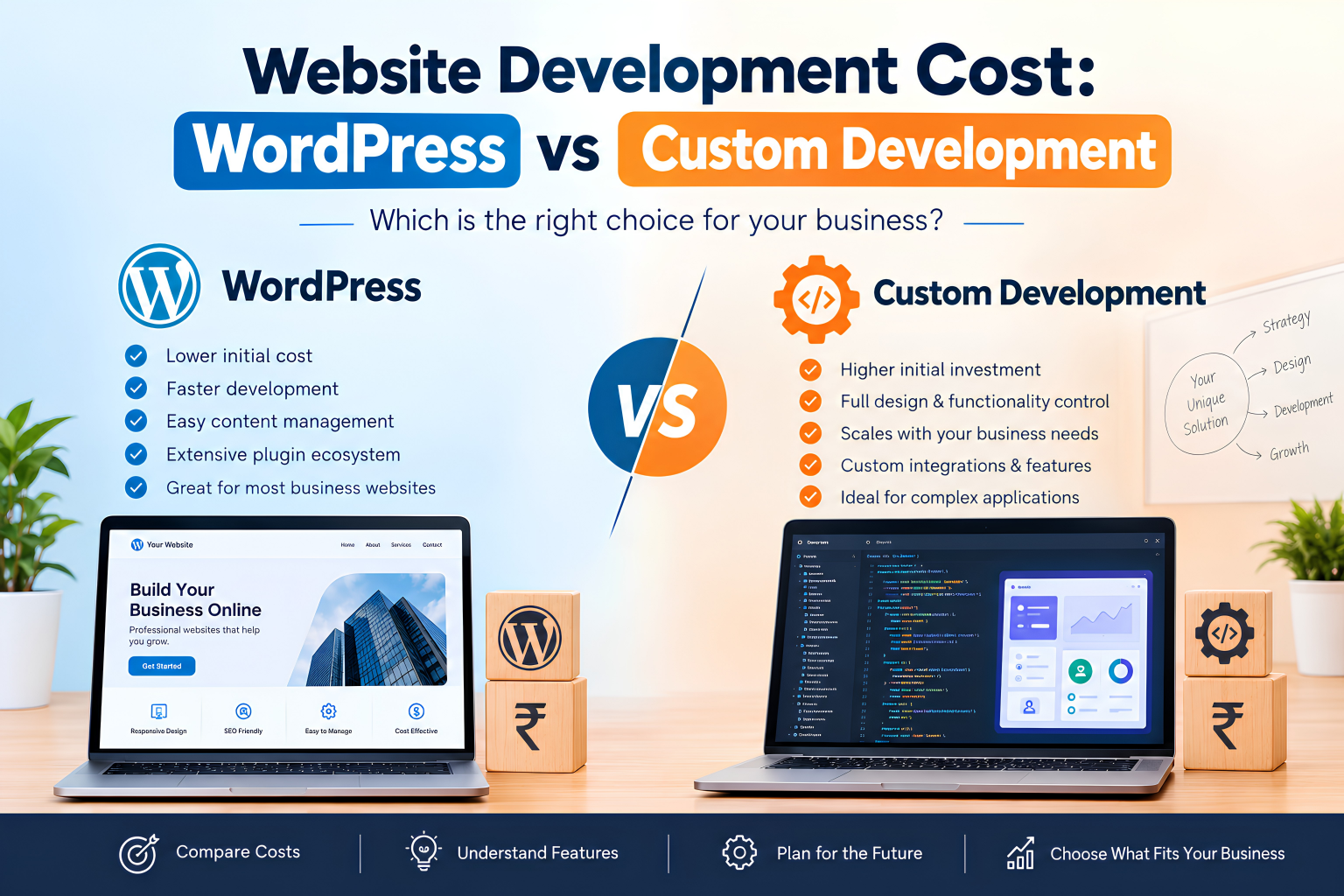
Website Development Cost: WordPress vs Custom Development
Understanding website development cost in India is one of the first questions businesses ask before starting a new website. But there is no single price that applies to every project. A five-page local business website, an e-commerce store, a healthcare portal, and a custom enterprise platform can have completely different budgets.
The biggest decision is often whether to build with WordPress or choose custom website development.
WordPress can provide a cost-effective and flexible foundation for many startups, SMEs, local businesses, publishers, and e-commerce companies. Custom development, meanwhile, can make more sense when a business needs specialized workflows, integrations, advanced security requirements, unique user experiences, or software-like functionality.
The right question is therefore not simply “Which is cheaper?” It is:
Which development approach delivers the functionality, scalability, performance, security, and long-term business value you actually need?
What Is the Average Website Development Cost in India?
As an indicative 2026 benchmark, website development projects in India can range from approximately ₹10,000 for a very basic website to several lakhs or more for sophisticated custom platforms. GoodFirms' 2026 market research places basic 5–10-page websites around ₹10,000–₹30,000, mid-sized websites around ₹30,000–₹80,000, CMS-based websites around ₹80,000–₹2,00,000, and custom web applications around ₹4,00,000–₹25,00,000.
These figures should be treated as planning ranges rather than fixed quotations.
| Website Type | Indicative Cost in India | Typical Use |
|---|---|---|
| Basic business website | ₹10,000–₹30,000 | Local businesses, simple portfolios |
| Professional business website | ₹30,000–₹80,000 | SMEs, professional services |
| Custom WordPress website | ₹80,000–₹2,00,000+ | Growing businesses, content-heavy sites |
| E-commerce website | ₹1,00,000–₹5,00,000+ | Online stores |
| Custom web application | ₹4,00,000–₹25,00,000+ | Complex business systems |
| Enterprise/web portal | ₹10,00,000+ | Large organizations and platforms |
The final website development price in India depends on design complexity, number of pages, integrations, content, functionality, technology stack, developer experience, testing, hosting, maintenance, and post-launch support.
WordPress Website Cost in India vs Custom Website Development Cost
The difference becomes clearer when comparing the two approaches.
| Factor | WordPress | Custom Development |
|---|---|---|
| Initial cost | Usually lower | Usually higher |
| Development speed | Faster | Longer |
| Design flexibility | High | Very high |
| Custom functionality | Moderate–high | Very high |
| Content management | Excellent | Requires CMS/admin development |
| Plugins/extensions | Large ecosystem | Built specifically for project |
| Scalability | Good with proper architecture | Excellent when engineered correctly |
| Maintenance | Updates required | Developer/technical maintenance required |
| Ownership | Platform is open source | Code can be fully customized |
| Best for | Most business websites | Complex or unique requirements |
WordPress remains a major part of the web ecosystem. As of September 2026, W3Techs reports that WordPress is used by 40.7% of all websites, representing 58.9% of websites whose CMS is known.
That does not mean WordPress is automatically the best choice. It means it has a mature ecosystem that businesses can leverage.
What Determines Website Development Cost in India?
The biggest mistake businesses make is comparing quotations without comparing scope.
1. Website Size
A 5-page website costs considerably less than a 100-page corporate platform.
The number of:
- Pages
- Landing pages
- Product pages
- Blog categories
- Locations
- User dashboards
- Forms
- Content types
all influence development effort.
2. Design Requirements
A ready-made theme can reduce development time. A completely custom UI/UX requires research, wireframing, design systems, responsive layouts, prototyping, and development.
3. Functionality
Features such as:
- Appointment booking
- Online payments
- Customer accounts
- Product filtering
- Membership systems
- CRM integration
- ERP integration
- WhatsApp integration
- APIs
- Advanced search
- Location-based services
can significantly increase project cost.
4. Technology
WordPress, Laravel, React, Next.js, Node.js, PHP, Python and other technologies have different development requirements.
5. Developer or Agency Experience
The WordPress developer cost in India can vary significantly depending on experience and project complexity.
Current Clutch listings show Indian WordPress providers ranging from below $25/hour to $100+/hour, demonstrating how widely professional rates can differ.
6. Integrations
Connecting a website with:
- Payment gateways
- CRM
- ERP
- Marketing automation
- Accounting software
- Inventory systems
- APIs
can add significant development and testing work.
7. Security and Compliance
Healthcare, finance, enterprise, and other sensitive-data projects may require stronger security controls, access management, auditing, backups, encryption, and compliance processes.
WordPress Website Development: Benefits and Features
Why Choose WordPress?
WordPress is often suitable when a business wants to launch quickly without sacrificing the ability to manage content independently.
Key advantages include:
- Faster development
- Lower entry cost
- Easy content management
- Large plugin ecosystem
- SEO-friendly architecture when properly configured
- Large developer community
- Easy integration with marketing tools
- Flexible themes and custom development
- Suitable for blogs, business websites and many e-commerce projects
A WordPress website does not have to look like a template-based website. Experienced developers can create custom themes and functionality while retaining WordPress as the content management system.
When WordPress Makes Sense
WordPress is particularly suitable for:
- Startups
- Local businesses
- Real estate companies
- Consultants
- Healthcare practices
- Restaurants
- Professional services
- Educational organizations
- Publishers
- Marketing websites
- Small and medium-sized e-commerce businesses
Custom Website Development: Benefits and Features
Custom development means the website or web application is engineered around the business requirements rather than relying primarily on an existing CMS/theme/plugin ecosystem.
It can provide:
- Bespoke user experiences
- Custom business workflows
- Advanced API integrations
- Complex databases
- Custom dashboards
- Role-based access
- High levels of automation
- Specialized performance requirements
- Greater architectural control
When Custom Development Makes Sense
Choose custom development when your project involves:
- Complex business logic
- Large-scale databases
- Multiple third-party systems
- Unique customer journeys
- Advanced user dashboards
- SaaS functionality
- Marketplace functionality
- Enterprise integrations
- Highly specialized security requirements
- Functionality that standard WordPress solutions cannot efficiently provide
WordPress vs Custom Development: Which Is Better?
There is no universal winner.
Choose WordPress when: speed, manageable costs, content management, marketing flexibility, and standard business functionality are your priorities.
Choose custom development when: your website is effectively becoming a software product and requires functionality that must be engineered specifically around your business.
A useful decision rule is:
If the website supports the business, WordPress may be sufficient. If the website is part of the business system itself, custom development may provide greater long-term flexibility.
Website Development Cost for Small Business in India
For small businesses, spending more does not automatically mean getting a better website.
A sensible small-business website budget should prioritize:
- Professional branding
- Mobile responsiveness
- Fast loading
- Clear calls-to-action
- Local SEO foundations
- Lead-generation forms
- Analytics
- Security
- Easy content updates
- Conversion-focused design
A properly planned WordPress website can often meet these requirements without the cost of building a complete custom platform.
For a local business, investing ₹2 lakh in unnecessary technology can be less valuable than investing ₹75,000 in a well-designed website plus SEO, content, local visibility and conversion optimization.
WordPress Website Development Cost in Delhi NCR and Noida
The WordPress website development cost in Delhi NCR can vary based on whether you hire a freelancer, boutique agency, or larger development company.
For businesses in Noida, Delhi, Gurgaon and the wider NCR region, compare providers based on:
- Portfolio quality
- Technical expertise
- SEO understanding
- Communication
- Project management
- Post-launch support
- Security practices
- Ownership of website assets
- Scope clarity
Do not select a provider simply because their initial quote is the lowest.
A low quotation that excludes hosting, premium plugins, content migration, responsive optimization, testing, security or maintenance can become more expensive later.
Hidden Costs Businesses Often Forget
Your development quotation is not necessarily your total website investment.
Budget for:
- Domain registration
- Hosting
- SSL/security
- Premium themes
- Premium plugins
- Professional copywriting
- Photography/video
- UI/UX design
- SEO
- Maintenance
- Backups
- Security monitoring
- Third-party APIs
- Payment gateway charges
- Email services
- CDN/performance services
Ask your developer for a three-year total cost of ownership, not just the initial development quotation.
Step-by-Step Website Development Process
Step 1: Define Business Goals
Determine whether the website's primary purpose is:
- Lead generation
- Sales
- Bookings
- Brand awareness
- Content publishing
- Customer support
- Online transactions
Step 2: Define Requirements
Create a detailed feature list before requesting quotations.
Step 3: Select Technology
Compare WordPress and custom development based on functionality rather than popularity.
Step 4: Plan UX and Information Architecture
Determine navigation, page structure, user journeys and conversion paths.
Step 5: Design
Create responsive layouts for desktop, tablet and mobile.
Step 6: Development
Build the website, integrations, CMS functionality and required features.
Step 7: Testing
Test:
- Mobile responsiveness
- Browsers
- Forms
- Payments
- Security
- Performance
- Accessibility
- Links
- Tracking
- Integrations
Step 8: SEO Setup
Implement:
- Metadata
- URL structure
- XML sitemap
- Robots directives
- Schema
- Internal links
- Canonicalization
- Image optimization
- Core Web Vitals improvements
Google recommends paying attention to real-world loading performance, responsiveness and visual stability through Core Web Vitals.
Step 9: Launch
Configure hosting, SSL, analytics, Search Console, redirects and backups.
Step 10: Continuous Optimization
A website should be treated as a business asset—not a one-time project.
Common Website Development Mistakes
Choosing the Cheapest Quote
A low price can be attractive, but inadequate planning, poor code quality or missing functionality can create higher long-term costs.
Starting Development Without a Specification
Undefined requirements lead to scope creep.
Ignoring SEO Until Launch
SEO should influence architecture, URLs, content structure and performance from the beginning.
Using Too Many Plugins
WordPress plugins can be useful, but unnecessary or poorly maintained plugins increase complexity and potential security/performance issues.
Forgetting Mobile Users
Your website must be designed for mobile users from the beginning.
Not Owning Your Website
Make sure you have access to:
- Domain
- Hosting
- Website files
- Database
- CMS
- Analytics
- Search Console
- Premium licenses
- Source code where applicable
Ignoring Maintenance
Security updates, backups, performance monitoring and content updates are ongoing requirements.
Best Practices for a High-ROI Website
A strong website should combine technology + UX + SEO + conversion strategy.
Follow these practices:
- Start with business objectives.
- Build mobile-first.
- Keep navigation simple.
- Use clear CTAs.
- Optimize Core Web Vitals.
- Use structured data where appropriate.
- Create genuinely useful content.
- Build topical authority.
- Track conversions, not just traffic.
- Optimize important landing pages continuously.
- Use first-hand expertise and credible sources.
- Keep software and dependencies updated.
Google's current guidance emphasizes helpful, reliable, people-first content and identifies experience, expertise, authoritativeness and trustworthiness as important concepts for evaluating content quality.
Website Development Trends in 2026
Several trends are changing how businesses approach web development.
AI-Assisted Development
AI can accelerate repetitive development and content workflows, but complex architecture, testing, security and business logic still require skilled human oversight.
Performance-First Development
Fast, responsive websites are increasingly important to user experience and search visibility.
Headless Architecture
Some larger organizations are separating the content management layer from the front-end experience for greater flexibility.
API-First Businesses
Websites increasingly connect with CRM, ERP, payment, analytics, marketing and AI systems.
AI Search and GEO
Businesses are optimizing content not only for traditional search rankings but also for AI-generated answers.
This makes concise definitions, trustworthy evidence, structured content, clear entities, FAQs and genuinely useful expertise increasingly valuable.
Hypothetical Case Study Examples
Example 1: Local Healthcare Clinic
A healthcare clinic needs 15 service pages, doctor profiles, appointment forms, Google Maps integration and a blog.
Recommended approach: Custom-designed WordPress.
Why? The clinic needs professional branding and SEO flexibility but does not necessarily need a completely custom software platform.
Example 2: Real Estate Company
A real estate company requires thousands of properties, advanced filtering, agent dashboards, CRM synchronization and automated property feeds.
Recommended approach: WordPress with carefully engineered custom functionality—or a custom application depending on integration complexity.
Example 3: SaaS Startup
A startup needs user registration, subscription management, dashboards, automated workflows and complex business logic.
Recommended approach: Custom web application.
Trying to force a software product into a collection of WordPress plugins may create unnecessary technical complexity.
How to Choose a Website Development Company in India
Before hiring a custom website development company in India, ask:
- Who owns the source code?
- What exactly is included in the quotation?
- Is UI/UX included?
- Is SEO included?
- What hosting is recommended?
- Are premium plugins/licenses included?
- What happens after launch?
- How are revisions handled?
- What security measures are implemented?
- What is the estimated total cost of ownership?
Also ask for relevant examples—not just a portfolio homepage.
The right partner should be able to explain why a particular technology and architecture is appropriate for your business.
Frequently Asked Questions
1. What is the website development cost in India?
Website development cost in India can range from roughly ₹10,000 for a basic website to several lakhs or more for advanced custom platforms. Actual pricing depends on scope, design, functionality, integrations and technology.
2. How much does a WordPress website cost in India?
A basic WordPress website may cost tens of thousands of rupees, while a professionally designed, custom WordPress website can cost ₹80,000–₹2,00,000 or more depending on functionality.
3. How much does custom website development cost in India?
Custom development can start around a few lakhs and increase substantially for complex applications, integrations, dashboards and enterprise requirements.
4. Is WordPress cheaper than custom development?
Usually, yes for standard business websites. WordPress can reduce development time and provide existing CMS functionality and plugins.
5. Is WordPress suitable for large businesses?
Yes. WordPress can support sophisticated websites when properly architected, optimized, secured and maintained. However, highly specialized enterprise applications may benefit from custom architecture.
6. What is the WordPress developer cost in India?
Rates vary significantly by experience, specialization and provider. Current industry listings show Indian WordPress providers across a broad pricing range.
7. What affects website development charges in India?
Major factors include design, number of pages, functionality, integrations, technology, developer experience, content, SEO, testing and maintenance.
8. How much does a small business website cost in India?
A basic small-business website can begin in the tens of thousands of rupees, while a more strategic professional website can cost considerably more depending on branding, SEO and functionality.
9. Does website hosting come with development?
Not necessarily. Hosting, domain registration, premium plugins, email services and maintenance should be clearly identified in the proposal.
10. Which is better for SEO: WordPress or custom development?
Neither automatically wins. SEO depends heavily on site architecture, content quality, performance, crawlability, technical implementation, authority and user experience.
11. Is custom development faster than WordPress?
Usually not for a standard business website. Custom development generally requires more planning, coding and testing.
12. Should startups choose WordPress or custom development?
Most startups should choose based on their actual product requirements. A marketing website often fits WordPress, while a technology product with complex workflows may need custom development.
13. What is the long-term cost of WordPress?
Consider hosting, domain, premium plugins, security, backups, updates, maintenance and development support—not only the initial build.
14. Can a WordPress website be customized?
Yes. WordPress can be customized through bespoke themes, plugins, integrations and custom development.
15. How can I reduce website development costs?
Define requirements early, prioritize essential features, avoid unnecessary custom functionality, use an appropriate technology stack and compare proposals based on total value rather than initial price.
Conclusion
The real question behind website development cost in India is not “How cheaply can I build a website?” but “What website will produce the best business outcome for my investment?”
For startups, SMEs and local businesses, WordPress can provide an excellent balance of cost, flexibility, speed and content management.
For enterprises, SaaS businesses, marketplaces and organizations with complex workflows, custom development can justify its higher initial investment through greater control and scalability.
Choose WordPress when you need a powerful business website. Choose custom development when you need a software solution built around your business.
The best technology is the one that matches your requirements—not the one with the lowest quotation.
Ready to Build the Right Website?
Before approving a website development budget, get your requirements, technology, features, timeline, ownership and ongoing costs documented.
A professional web development consultation can help you determine whether WordPress or custom development is the more cost-effective choice for your business.
Request a website consultation and get a technology recommendation based on your business goals, functionality and budget.