

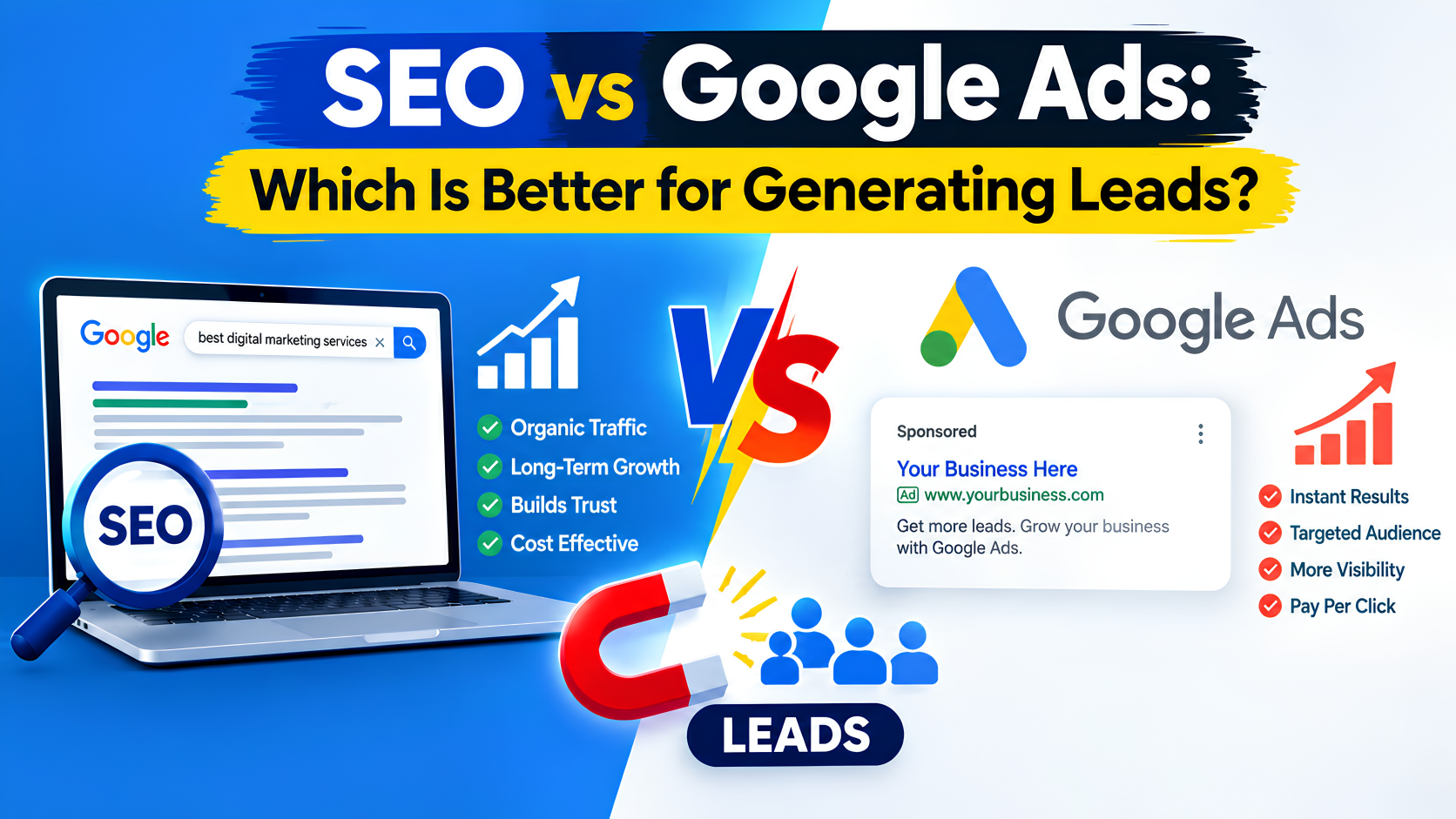
SEO vs Google Ads: Which Is Better for Generating Leads?
SEO vs Google Ads: Which Is Better for Generating Leads?
SEO Title: SEO vs Google Ads: Which Is Better for Leads?
Meta Description: SEO vs Google Ads for lead generation: compare cost, speed, ROI, scalability, and long-term value to choose the right strategy for your business.
URL Slug: /seo-vs-google-ads-for-lead-generation/
Primary Keyword: SEO vs Google Ads for Lead Generation
Secondary Keywords: SEO vs Google Ads, SEO vs PPC, SEO or Google Ads, SEO vs PPC for lead generation, Google Ads vs SEO, SEO vs Google Ads ROI, SEO vs Google Ads which is better for generating leads, SEO vs Google Ads for small businesses, SEO vs PPC which is better for lead generation, Is SEO better than Google Ads for lead generation, SEO vs Google Ads cost comparison, SEO vs Google Ads ROI comparison, SEO or PPC for lead generation
Introduction
SEO vs Google Ads for Lead Generation is not really a question of which channel is universally better. The better choice depends on how quickly you need leads, your budget, customer lifetime value, competition, sales cycle, and whether you want immediate demand capture or sustainable organic visibility.
SEO builds visibility in unpaid search results by improving your website, content, authority, and technical foundation. Google Ads, meanwhile, allows businesses to pay for advertising opportunities when users search for relevant terms or interact with Google's advertising network.
For most businesses, the strongest strategy is not SEO versus Google Ads, but SEO plus Google Ads.
SEO vs Google Ads: What's the Difference?
| Factor | SEO | Google Ads |
|---|---|---|
| Traffic source | Organic search | Paid search |
| Speed | Usually slower | Usually faster |
| Initial media cost | No payment for organic clicks | Pay for advertising clicks/actions |
| Long-term value | High potential | Requires continued budget |
| Control | Lower over exact placement | Greater campaign control |
| Testing | Slower | Fast keyword/ad/landing-page testing |
| Brand authority | Can strengthen organic credibility | Strong visibility but marked as advertising |
| Scalability | Content and rankings can scale | Budget can scale campaigns |
| Best for | Sustainable demand generation | Immediate demand capture |
| Main risk | Takes time and requires ongoing work | Costs can rise with competition and weak conversion rates |
Google emphasizes that appearing in organic Search does not require payment, although meeting technical and quality requirements does not guarantee crawling, indexing, or rankings.
How SEO Generates Leads
SEO generates leads by matching your website with people actively searching for problems, products, services, or solutions.
A strong SEO lead-generation system typically includes:
- Keyword research based on commercial and informational intent
- Technical SEO
- Service and landing pages
- Local SEO where relevant
- Helpful expert-led content
- Internal linking
- Digital PR and authoritative mentions
- Conversion-focused website design
- Structured data where appropriate
- Analytics and conversion tracking
For example, a software company could target searches such as:
- custom CRM development company
- AI chatbot development company
- SaaS development company
- healthcare software development
- offshore software development
The objective isn't simply to generate traffic. It is to attract qualified searchers who have a realistic possibility of becoming customers.
Google's current guidance emphasizes helpful, reliable, people-first content and clear demonstrations of expertise, experience, authority, and trust.
How Google Ads Generates Leads
Google Ads can place your business in front of users searching for relevant commercial terms without waiting for organic rankings to develop.
The basic process is:
- Identify high-intent keywords.
- Create relevant ad groups and advertisements.
- Build dedicated landing pages.
- Set targeting, bidding, and budget parameters.
- Launch campaigns.
- Track calls, forms, purchases, bookings, or other conversions.
- Optimize keywords, ads, audiences, bids, and landing pages.
- Scale profitable campaigns.
Importantly, Google Ads is not simply a matter of paying the most. Google's Ad Rank system considers factors including bid, ad and landing-page quality, competition, search context, thresholds, and expected impact of ad assets.
Google also describes Quality Score as a diagnostic tool that helps advertisers understand the relevance and usefulness of their ads and landing pages; it is not itself a KPI or direct auction input.
SEO vs Google Ads for Lead Generation: Which Is Better?
Choose SEO when:
- You want sustainable organic traffic.
- Your business has a longer growth horizon.
- Your customers research before contacting you.
- You can consistently create useful content.
- Your industry has valuable non-branded search demand.
- You want to build topical authority.
- You want visibility across traditional and AI-powered search experiences.
Choose Google Ads when:
- You need leads quickly.
- Your service has strong commercial search intent.
- You have a defined advertising budget.
- You have a conversion-ready landing page.
- You want to test demand before making a larger SEO investment.
- You need granular campaign and keyword control.
Choose both when:
- You need short-term and long-term lead generation.
- You operate in a highly competitive search market.
- You want paid data to inform SEO priorities.
- You want to dominate multiple areas of the search results.
- Your customer acquisition economics support both channels.
Expert recommendation: For most established businesses, use Google Ads to capture immediate demand while building SEO as a compounding acquisition asset.
SEO vs Google Ads Cost Comparison
One of the biggest misconceptions is that SEO is "free" and Google Ads is "expensive."
Neither statement is sufficiently accurate.
SEO does not charge you for every organic click, but effective SEO requires investment in strategy, technical work, content, expertise, links/authority development, conversion optimization, and ongoing measurement.
Google Ads has direct media costs, while campaign management and landing-page optimization may add additional costs.
A better comparison is:
SEO acquisition economics
SEO investment ÷ qualified organic leads
Google Ads acquisition economics
Advertising + management costs ÷ qualified paid leads
But lead volume alone isn't enough. A better business metric is:
Cost per qualified lead → Sales conversion rate → Customer acquisition cost → Customer lifetime value
A channel generating 100 low-quality leads may be less valuable than one generating 20 highly qualified opportunities.
SEO vs Google Ads ROI: What Should You Measure?
Don't evaluate either channel using traffic alone.
Track:
- Qualified leads
- Cost per qualified lead
- Conversion rate
- Sales-qualified leads
- Lead-to-customer rate
- Customer acquisition cost
- Revenue generated
- Average deal value
- Customer lifetime value
- Return on advertising spend where applicable
- Assisted conversions
- Branded vs non-branded demand
For B2B businesses, CRM integration is particularly important because the "conversion" should ideally connect to actual sales outcomes rather than stopping at a form submission.
A Practical Lead-Generation Strategy
A combined SEO and PPC strategy can follow this six-step process.
1. Identify commercial search intent
Separate keywords into:
- Informational
- Commercial investigation
- Transactional
- Local
- Branded
Prioritize keywords that have a realistic connection to revenue.
2. Build conversion-focused landing pages
Each important service should have a page that answers:
- What problem do you solve?
- Who do you serve?
- Why should customers trust you?
- What makes your solution different?
- What evidence supports your claims?
- What should the visitor do next?
3. Use Google Ads for immediate testing
Test commercial keywords and landing pages.
The resulting search-term, conversion, and lead-quality data can reveal which problems and offers deserve deeper organic investment.
4. Build SEO around validated demand
Create authoritative service pages, supporting content, comparison pages, FAQs, case studies, and industry-specific resources.
5. Optimize for conversions
Improve:
- Calls to action
- Forms
- Page speed
- Mobile UX
- Trust signals
- Case studies
- Testimonials
- Pricing clarity where appropriate
- Contact options
6. Measure revenue, not vanity metrics
Connect Search Console, Analytics, advertising platforms, and CRM data where possible.
How AI Search Changes the SEO vs PPC Decision
Search is becoming more conversational and increasingly incorporates generative AI experiences.
Google states that its AI Overviews and AI Mode use relevant web content and existing Search systems to provide answers and supporting links. Google also says that existing SEO fundamentals remain relevant for these experiences.
That means businesses should not abandon SEO because users are interacting with AI.
Instead, invest in:
- Original expert content
- Clear answers to complex questions
- Strong topical coverage
- First-hand experience
- Trustworthy authorship
- Technical accessibility
- Internal linking
- Structured, understandable content
- Original research and case studies
- Strong brand/entity signals
Google's latest guidance specifically recommends valuable, unique, non-commodity content rather than trying to exploit supposed "GEO hacks."
For TGAYS Technology, this is particularly relevant because its website already covers AI development, software, SaaS, CRM, healthcare, finance, e-commerce, education, and other technology solutions, alongside case studies and global client experience.
Industry-Specific Recommendations
Startups
Use Google Ads to validate high-intent demand quickly while building SEO around the problem your product solves.
SMEs
A hybrid strategy is often effective: local/commercial SEO for sustainable visibility plus PPC for immediate lead acquisition.
Enterprises
Prioritize SEO, content authority, technical SEO, digital PR, and high-value paid campaigns for strategic commercial terms.
Healthcare
Combine high-quality informational content, strong trust signals, local SEO, and carefully controlled paid campaigns. Accuracy and credibility should take priority over aggressive keyword targeting.
Real Estate
Use Google Ads for location-specific and high-intent searches while building local organic visibility and neighborhood/property content.
E-commerce
Combine SEO category/product optimization with paid campaigns for products and high-commercial-intent searches.
Common Mistakes
1. Treating SEO as free traffic
SEO requires continuous investment and expertise.
2. Treating Google Ads as guaranteed leads
A click is not a lead. A lead is not a customer.
3. Sending every PPC visitor to the homepage
Dedicated landing pages often provide a clearer path from search intent to conversion.
4. Optimizing for traffic instead of revenue
High traffic with poor lead quality can produce weak business results.
5. Ignoring negative keywords
Poor keyword targeting can waste paid budget.
6. Publishing generic AI-generated content
Google advises that AI-assisted content should still satisfy its Search Essentials and spam policies; mass-produced content without meaningful added value can create problems.
7. Measuring channels in isolation
Customers may interact with multiple marketing channels before converting.
Best Practices for Maximum Lead Generation
- Build SEO around customer problems and commercial intent.
- Use PPC to test high-value search demand.
- Create dedicated landing pages.
- Track qualified leads rather than raw conversions.
- Connect marketing data with your CRM.
- Continuously improve page experience.
- Build genuine authority through useful expertise.
- Use first-party data wherever possible.
- Refresh important content as markets change.
- Test offers, messaging, and CTAs.
- Use Google Search Console to understand organic performance.
- Monitor visibility in emerging AI search experiences.
Google's current documentation recommends Search Console for diagnosing search visibility and measuring performance in AI-powered Search experiences.
Example: SaaS Company
Imagine a SaaS company selling CRM software.
Google Ads strategy:
Target high-intent searches such as:
- CRM software for small business
- custom CRM development
- enterprise CRM solution
Create dedicated landing pages and measure qualified demos.
SEO strategy:
Build content around:
- CRM implementation
- CRM integration
- CRM automation
- CRM vs ERP
- CRM software comparison
- industry-specific CRM solutions
Best approach: Use PPC to capture immediate commercial demand while SEO builds long-term topical authority.
Example: Local Service Business
A local healthcare, real estate, home-services, or professional-services company may combine:
Paid search
→ Capture people actively looking for a provider now.
Local SEO
→ Build visibility in geographically relevant searches.
Organic content
→ Answer research-stage questions.
Conversion optimization
→ Turn visitors into calls, forms, appointments, or consultations.
This creates a full-funnel acquisition system rather than relying on a single channel.
FAQs
1. Is SEO better than Google Ads for lead generation?
Not universally. SEO is generally stronger for sustainable organic acquisition, while Google Ads can be better when immediate demand capture is the priority.
2. Is Google Ads better than SEO for generating leads?
It can be, particularly when a business needs leads quickly and targets high-intent searches. Results depend on competition, targeting, landing-page quality, offer, and conversion economics.
3. Which is cheaper, SEO or Google Ads?
There is no universal answer. Google Ads has direct advertising costs, while SEO requires investment in people, content, technology, and ongoing optimization.
4. Does SEO generate better-quality leads?
It can. Organic search often captures users researching a problem over multiple stages of the buying journey, but lead quality depends heavily on keyword intent and landing-page relevance.
5. How long does SEO take to generate leads?
There is no guaranteed timeline. Results depend on competition, website authority, technical condition, content quality, search demand, and implementation.
6. How quickly can Google Ads generate leads?
Potentially immediately after campaigns become eligible to serve, but generating profitable leads requires proper targeting, conversion tracking, ads, landing pages, and optimization.
7. Should a small business use SEO or Google Ads?
Many small businesses benefit from using both strategically. PPC can provide immediate demand capture while SEO builds sustainable visibility.
8. Can SEO and Google Ads work together?
Yes. Paid search data can help identify commercially valuable keywords and messaging, while SEO can build organic visibility around validated customer demand.
9. Is SEO still important with AI search?
Yes. Google states that foundational SEO remains relevant to its generative AI search experiences.
10. What is more important: traffic or leads?
Leads are more directly connected to business growth, but qualified leads and revenue are even better measures.
11. Should I invest in SEO before Google Ads?
Not necessarily. If you need immediate demand, PPC may be appropriate while SEO is developed simultaneously.
12. What is the best SEO vs PPC strategy?
A strong strategy combines commercial SEO, high-intent PPC, conversion optimization, analytics, and CRM-based lead-quality measurement.
Conclusion
So, SEO vs Google Ads for Lead Generation: which is better?
The answer depends on your business objectives.
Google Ads wins for speed and controllable demand capture. SEO wins for sustainable organic visibility and long-term acquisition potential.
For businesses with sufficient resources, the strongest approach is usually a hybrid SEO + Google Ads strategy:
Google Ads → immediate demand
SEO → sustainable visibility
Conversion optimization → better lead rates
CRM analytics → better lead quality
AI-ready SEO → broader search visibility
Rather than asking "SEO or Google Ads?", ask:
"Which combination can produce qualified customers at an acceptable acquisition cost while building long-term business value?"
That is the question that should drive your marketing budget.
Ready to Build a Lead-Generation Strategy?
TGAYS Technology works with startups, SMEs, enterprises, and businesses across multiple industries, including healthcare, finance, e-commerce, education, and travel. Its technology portfolio includes digital marketing, AI-powered solutions, websites, mobile applications, SaaS, CRM, custom software, and offshore development.
Talk to TGAYS Technology about building an SEO, paid-search, website, and conversion strategy aligned with your business goals.
Article Summary
SEO vs Google Ads for Lead Generation is not a one-size-fits-all decision. Google Ads can provide faster access to high-intent searches, while SEO can create sustainable organic visibility and long-term acquisition value. The best strategy for many businesses is to combine both channels, using PPC for immediate demand and testing while SEO develops authority and organic reach. The final decision should be based on qualified leads, customer acquisition cost, conversion rates, revenue, and lifetime customer value—not traffic alone.