

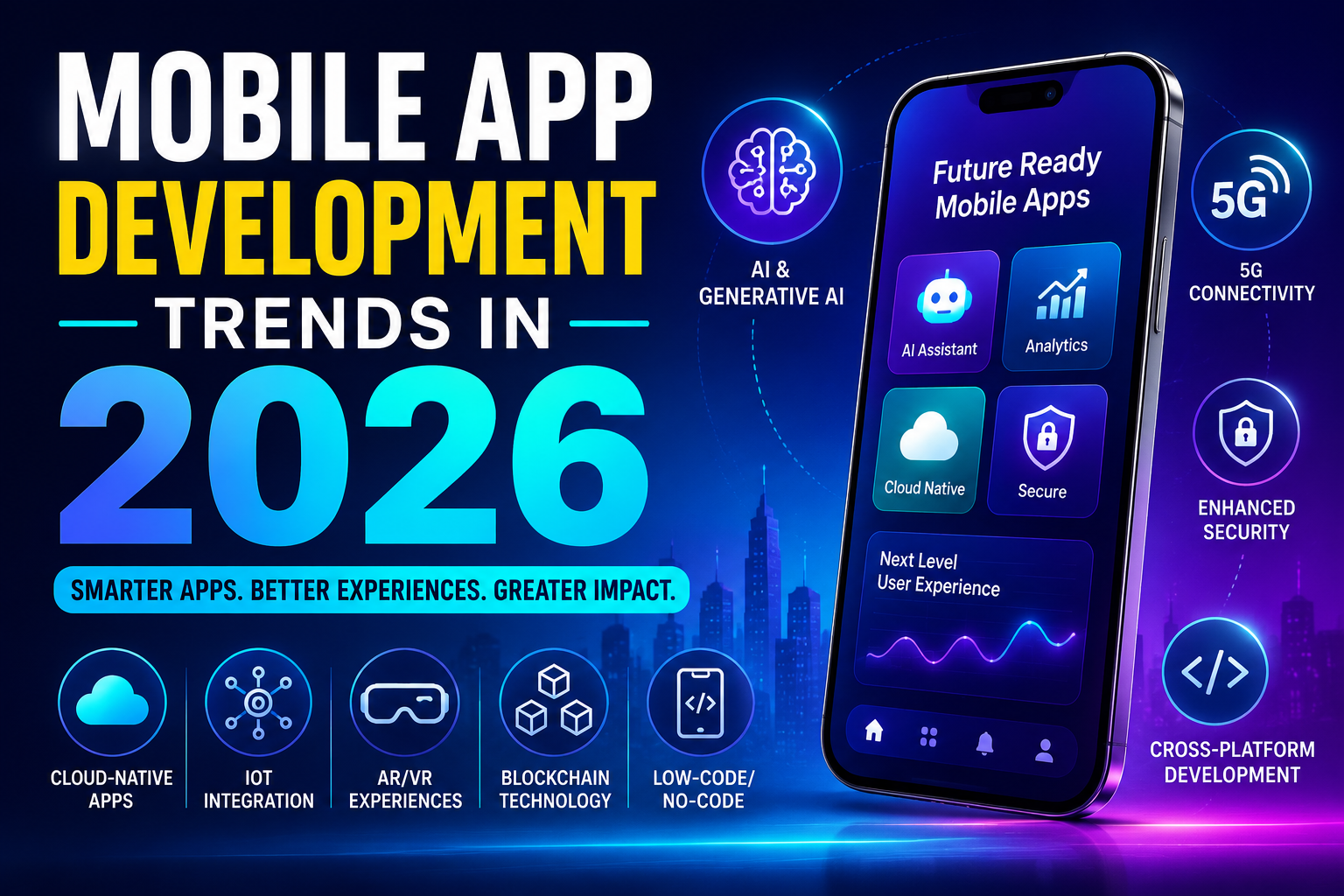
Mobile App Development Trends in 2026
Mobile App Development Trends in 2026 are reshaping how businesses engage customers, streamline operations, and accelerate digital transformation. With Artificial Intelligence (AI), 5G connectivity, cloud computing, edge computing, cross-platform frameworks, and advanced security becoming mainstream, mobile applications are evolving into intelligent business platforms rather than simple digital tools.
Whether you're a startup launching your first MVP, an SME improving customer engagement, or an enterprise modernising legacy systems, understanding the latest mobile app development trends in 2026 is essential for building future-ready applications.
Businesses across Noida, India, the USA, Australia, the UK, and Dubai are increasingly investing in AI-powered mobile applications that deliver personalised experiences, automate business processes, and improve operational efficiency.
This comprehensive guide explores the most important mobile app development trends in 2026, explains their business impact, and provides practical insights to help organisations build scalable, secure, and innovative mobile applications.
Quick Definition (Featured Snippet Optimised)
What Are Mobile App Development Trends in 2026?
Mobile App Development Trends in 2026 refer to the latest technologies, frameworks, design approaches, and development practices that influence how modern mobile applications are built, deployed, secured, and maintained.
These trends include:
- Artificial Intelligence (AI)
- Generative AI
- AI Chatbots
- Machine Learning
- 5G Connectivity
- Cross-Platform Development
- Cloud-Native Applications
- Edge Computing
- Low-Code Development
- Enhanced Mobile Security
- Internet of Things (IoT)
- Augmented Reality (AR)
- Predictive Analytics
Mobile App Development at a Glance
| Traditional Mobile Apps | Modern Mobile Apps (2026) |
|---|---|
| Static Features | AI-Powered Experiences |
| Manual Processes | Intelligent Automation |
| Limited Personalisation | Hyper-Personalisation |
| Basic Search | Conversational AI Search |
| Simple Notifications | Predictive Engagement |
| Standard Security | Zero-Trust Security |
| Single Platform | Cross-Platform Development |
| Cloud Optional | Cloud-First Architecture |
Why Mobile App Development Is Changing Rapidly
Consumer expectations continue to rise. Users now expect applications that are:
- Fast
- Intelligent
- Secure
- Personalised
- Available across devices
- Always connected
- Easy to use
- Powered by AI
At the same time, businesses need applications that can:
- Scale efficiently
- Reduce operational costs
- Improve employee productivity
- Increase customer engagement
- Generate actionable business insights
- Integrate with existing enterprise systems
These changing expectations are driving innovation across the mobile app industry.
The Problem: Challenges Businesses Face Without Modern Mobile Apps
Many organisations still rely on outdated applications that cannot support modern customer expectations or business processes.
Common challenges include:
Poor User Experience
Older applications often suffer from:
- Slow loading speeds
- Confusing navigation
- Limited personalisation
- Frequent crashes
- Inconsistent performance
This leads to reduced customer satisfaction and lower retention rates.
Limited Automation
Without AI and automation, businesses spend significant time on manual tasks such as:
- Customer support
- Data entry
- Scheduling
- Order processing
- Reporting
Modern AI-enabled mobile applications automate these processes, improving efficiency and reducing operational costs.
Security Risks
Cyber threats targeting mobile applications continue to increase.
Common vulnerabilities include:
- Weak authentication
- Unencrypted data
- Poor API security
- Outdated software components
Modern mobile app development prioritises security from the design stage.
Increasing Development Costs
Building separate Android and iOS applications increases:
- Development time
- Maintenance costs
- Testing efforts
- Feature rollout delays
Cross-platform frameworks now enable faster delivery while maintaining a high-quality user experience.
Why Businesses Should Follow Mobile App Development Trends in 2026
Ignoring technological advancements can result in:
- Lower customer engagement
- Competitive disadvantages
- Higher operational costs
- Poor scalability
- Reduced app downloads
- Increased churn rates
Organisations that adopt emerging technologies early are better positioned to innovate, improve customer experiences, and respond quickly to changing market demands.
Top Mobile App Development Trends in 2026 (Part 1)
1. Artificial Intelligence (AI) Becomes the Core of Mobile Apps
AI is no longer an optional feature—it is becoming the foundation of modern mobile applications.
Businesses are integrating AI to:
- Automate workflows
- Personalise user experiences
- Analyse customer behaviour
- Improve recommendations
- Enhance customer support
- Optimise business processes
Business Benefits
- Higher customer engagement
- Better decision-making
- Reduced operational costs
- Increased productivity
- Improved customer satisfaction
Example: An e-commerce app can recommend products based on browsing history, purchase patterns, and real-time behaviour, creating a more personalised shopping experience.
2. Generative AI in Mobile Applications
Generative AI is transforming how users interact with mobile apps by enabling applications to generate content, provide intelligent responses, and assist with complex tasks.
Common use cases include:
- AI writing assistants
- Code generation
- Customer support automation
- Personalised recommendations
- Image generation
- Voice assistants
- Document summarisation
- AI-powered search
Industries Benefiting
- Healthcare
- Education
- Finance
- Retail
- Real Estate
- Legal Services
- Travel
- Manufacturing
3. AI Chatbot Integration in Mobile Apps
Businesses are increasingly deploying AI chatbots to provide instant customer support and improve user engagement.
Modern AI chatbots can:
- Answer frequently asked questions
- Schedule appointments
- Track orders
- Recommend products
- Resolve common issues
- Collect customer feedback
Benefits
- 24/7 customer support
- Reduced support costs
- Faster response times
- Improved customer satisfaction
4. Machine Learning for Smarter User Experiences
Machine Learning enables mobile apps to learn from user behaviour and improve over time.
Examples include:
- Fraud detection
- Predictive search
- Personalised recommendations
- Dynamic pricing
- Health monitoring
- Smart notifications
The more data the application processes, the more accurate and valuable its recommendations become.
5. Cross-Platform App Development Continues to Dominate
Businesses increasingly prefer cross-platform frameworks because they reduce development costs while accelerating time to market.
Popular technologies include:
- Flutter
- React Native
- .NET MAUI
- Kotlin Multiplatform
Advantages
- Single codebase
- Faster deployment
- Lower maintenance costs
- Consistent user experience
- Easier updates
6. Cloud-Native Mobile Applications
Cloud-native architecture allows mobile apps to scale efficiently while supporting real-time data synchronisation across devices.
Benefits include:
- Improved scalability
- Automatic backups
- Faster deployments
- Better collaboration
- Lower infrastructure costs
Cloud-native development is particularly valuable for SaaS platforms, enterprise applications, and collaboration tools.
Key Benefits of Modern Mobile App Development
| Benefit | Business Impact |
|---|---|
| AI Automation | Improves productivity and reduces manual work |
| Cross-Platform Development | Faster delivery with lower costs |
| Cloud Integration | Better scalability and reliability |
| AI Chatbots | 24/7 customer support and engagement |
| Machine Learning | Personalised user experiences |
| Enhanced Security | Better protection against cyber threats |
| Faster Performance | Improved user satisfaction and retention |
| Business Intelligence | Data-driven decision-making |
The most successful mobile applications in 2026 will not simply offer more features—they will deliver intelligent, personalised, secure, and seamless experiences. Businesses that combine AI, cloud-native architecture, strong security practices, and user-centric design will be better positioned to improve customer engagement, streamline operations, and achieve long-term digital growth.
Top Mobile App Development Trends in 2026
As businesses continue their digital transformation journeys, several emerging technologies are redefining how mobile applications are designed, developed, and maintained. These trends are enabling organisations to deliver faster, more secure, and highly personalised user experiences.
7. 5G-Powered Mobile Applications
The global expansion of 5G networks is unlocking new possibilities for mobile applications by providing ultra-low latency, faster data transfer, and improved connectivity.
Business Applications
- HD video streaming
- Cloud gaming
- Remote healthcare consultations
- Smart manufacturing
- Real-time collaboration
- Connected vehicle applications
- Live commerce platforms
Benefits
- Faster application performance
- Improved user experience
- Better support for real-time features
- Reduced latency
- Higher customer engagement
8. Internet of Things (IoT) Integration
Mobile applications are becoming the primary interface for managing connected devices.
Common IoT Use Cases
- Smart homes
- Wearable health devices
- Fleet management
- Industrial monitoring
- Smart agriculture
- Energy management
- Smart retail
Business Benefits
- Real-time monitoring
- Predictive maintenance
- Better operational efficiency
- Improved customer experiences
- Automated workflows
9. Augmented Reality (AR) and Virtual Reality (VR)
AR and VR continue to transform customer engagement by creating immersive digital experiences.
Industries Adopting AR/VR
| Industry | Example Use Cases |
|---|---|
| Retail | Virtual product try-ons |
| Healthcare | Medical training and patient education |
| Real Estate | Virtual property tours |
| Education | Interactive learning |
| Manufacturing | Equipment maintenance guidance |
| Tourism | Virtual destination previews |
Benefits
- Higher user engagement
- Improved buying confidence
- Better learning experiences
- Reduced product returns
- Enhanced brand differentiation
10. Advanced Mobile App Security
Cybersecurity remains one of the highest priorities in modern mobile application development.
Security Trends in 2026
- Multi-factor authentication (MFA)
- Biometric authentication
- End-to-end encryption
- Secure APIs
- Zero Trust architecture
- AI-powered threat detection
- Privacy-by-design principles
Best Practices
- Encrypt sensitive data
- Perform regular security testing
- Use secure authentication mechanisms
- Keep third-party libraries updated
- Conduct vulnerability assessments
11. Low-Code and No-Code Development
Low-code platforms are accelerating application delivery by enabling developers and business teams to build applications with minimal coding.
Advantages
- Faster development cycles
- Reduced development costs
- Rapid prototyping
- Improved collaboration
- Faster time-to-market
These platforms are particularly useful for internal business applications and workflow automation, while complex enterprise solutions still benefit from custom development.
12. Blockchain Integration in Mobile Apps
Blockchain technology is expanding beyond cryptocurrency into mainstream mobile applications.
Popular Use Cases
- Digital identity verification
- Secure payments
- Smart contracts
- Supply chain tracking
- Healthcare records
- NFT marketplaces
- Loyalty programmes
Benefits
- Greater transparency
- Enhanced security
- Tamper-resistant records
- Improved trust
- Reduced fraud
13. Edge Computing for Mobile Applications
Edge computing processes data closer to the user rather than relying entirely on central cloud servers.
Benefits
- Lower latency
- Faster response times
- Reduced bandwidth usage
- Better offline capabilities
- Improved application performance
This is especially valuable for IoT, autonomous systems, and real-time analytics.
AI in Mobile App Development
Artificial Intelligence is no longer a value-added feature—it is becoming the foundation of next-generation mobile applications.
How AI Is Transforming Mobile Apps
AI enables applications to:
- Learn user behaviour
- Deliver personalised content
- Automate customer interactions
- Predict user needs
- Improve search accuracy
- Detect fraud
- Optimise app performance
- Analyse customer feedback
AI-Powered Features Businesses Should Consider
| AI Feature | Business Value |
|---|---|
| Smart Recommendations | Increase conversions and engagement |
| AI Chatbots | 24/7 customer support |
| Predictive Analytics | Better business decisions |
| Voice Search | Improved accessibility |
| Image Recognition | Faster identification and automation |
| Personalised Notifications | Higher retention rates |
| Fraud Detection | Improved security |
| Intelligent Search | Better user experience |
Step-by-Step Process for Building a Future-Ready Mobile App
A successful mobile application begins with a structured development process.
Step 1: Define Business Goals
Identify:
- Target audience
- Business objectives
- Core features
- Revenue model
- Success metrics
Step 2: Conduct Market Research
Analyse:
- Competitors
- User expectations
- Industry trends
- Customer pain points
- Technology opportunities
Step 3: Choose the Right Technology Stack
Examples include:
| Requirement | Recommended Technology |
|---|---|
| Cross-Platform | Flutter, React Native |
| Native Android | Kotlin |
| Native iOS | Swift |
| Backend | Node.js, .NET, Java |
| Database | PostgreSQL, MongoDB |
| Cloud | AWS, Azure, Google Cloud |
| AI Integration | OpenAI APIs, Gemini APIs, custom ML models |
Step 4: Design User-Centred Experiences
Focus on:
- Simple navigation
- Fast loading
- Accessibility
- Responsive layouts
- Consistent branding
- Intuitive interfaces
Step 5: Develop and Integrate AI Features
Prioritise AI capabilities that align with business goals, such as:
- Personalised recommendations
- Conversational assistants
- Predictive analytics
- Automated notifications
- Smart search
Step 6: Test Thoroughly
Testing should include:
- Functional testing
- Performance testing
- Security testing
- Compatibility testing
- Accessibility testing
- User acceptance testing (UAT)
Step 7: Launch, Monitor, and Improve
Post-launch activities include:
- Performance monitoring
- User feedback collection
- Feature enhancements
- Security updates
- Analytics reviews
- Continuous optimisation
Industry-Specific Applications
Healthcare
Healthcare organisations are building AI-powered applications for:
- Appointment scheduling
- Telemedicine
- Patient monitoring
- Electronic health records
- Medication reminders
- Clinical decision support
E-commerce
Retail businesses leverage mobile apps for:
- Personalised shopping
- AI product recommendations
- Digital payments
- Order tracking
- Loyalty programmes
- Customer engagement
Real Estate
Real estate companies use mobile apps to:
- Showcase property listings
- Offer virtual tours
- Manage leads
- Schedule viewings
- Send market updates
Financial Services
Banks and fintech companies benefit from:
- Secure digital banking
- AI-powered fraud detection
- Expense tracking
- Investment insights
- Digital wallets
Education
Educational institutions use mobile apps for:
- Online learning
- Live classes
- Assessments
- Student communication
- AI tutoring assistants
Real-World Case Study Examples
Case Study 1: AI-Powered Retail Application
Challenge: An online retailer wanted to improve customer engagement and increase average order value.
Solution: The company integrated AI-based product recommendations, personalised offers, and an AI shopping assistant.
Results:
- Higher user engagement
- Improved conversion rates
- Increased average order value
- Better customer retention
Case Study 2: Healthcare Mobile Application
Challenge: A healthcare provider needed to reduce appointment scheduling delays and improve patient communication.
Solution: An AI-enabled mobile app automated appointment booking, reminders, and common patient queries.
Results:
- Reduced administrative workload
- Faster appointment scheduling
- Improved patient satisfaction
- Lower no-show rates
Case Study 3: Enterprise Workforce App
Challenge: A large organisation struggled with manual approvals and inefficient internal communication.
Solution: A custom mobile application integrated workflow automation, AI assistants, and document management.
Results:
- Faster approvals
- Improved employee productivity
- Reduced paperwork
- Better collaboration across departments
Mobile App Development Statistics and Industry Insights
The mobile app landscape continues to evolve rapidly. Several industry-wide trends are shaping investment decisions:
| Trend | Business Insight |
|---|---|
| AI is becoming a standard feature in modern mobile apps | Businesses are embedding intelligent capabilities to personalise experiences and automate tasks. |
| Cross-platform development continues to grow | Organisations are reducing costs and accelerating launches with shared codebases. |
| Mobile commerce remains a major digital sales channel | Consumers increasingly prefer purchasing through mobile applications. |
| Security and privacy are now key purchasing factors | Users expect strong data protection and transparent privacy practices. |
| Continuous updates outperform one-time releases | Businesses adopting agile development and regular feature releases achieve better long-term engagement. |
Common Mistakes in Mobile App Development
Even with the latest technologies available, many businesses fail to achieve their desired outcomes because they overlook critical planning and execution steps.
1. Building an App Without Market Research
Launching an app without understanding customer needs often results in poor adoption and low engagement.
Solution:
- Conduct competitor analysis
- Gather user feedback
- Validate the idea with an MVP
- Define clear user personas
2. Ignoring User Experience (UX)
A feature-rich app with poor usability will struggle to retain users.
Common UX Issues:
- Slow loading times
- Complex navigation
- Cluttered interfaces
- Poor accessibility
- Inconsistent design
Solution: Adopt a user-first design approach with intuitive navigation and performance optimisation.
3. Choosing the Wrong Technology Stack
Selecting technologies that don't align with long-term goals can increase maintenance costs and limit scalability.
Solution: Evaluate your requirements carefully and choose frameworks, cloud services, and databases that support future growth.
4. Neglecting Security
Failing to implement security best practices can expose users to data breaches and damage brand trust.
Best Practices:
- Encrypt sensitive data
- Secure APIs
- Implement multi-factor authentication
- Conduct regular penetration testing
- Keep dependencies updated
5. Treating AI as a Gimmick
Adding AI features without solving a real user problem can complicate the user experience and increase costs.
Solution: Implement AI where it provides measurable value, such as personalised recommendations, intelligent search, predictive analytics, or customer support automation.
Best Practices for Mobile App Development in 2026
Prioritise User-Centric Design
Design every feature with the end user in mind by focusing on:
- Simplicity
- Speed
- Accessibility
- Personalisation
- Consistency
Adopt an AI-First Strategy
Integrate AI where it improves business outcomes, including:
- Smart recommendations
- AI chatbots
- Voice assistants
- Predictive analytics
- Automated workflows
Build for Scalability
Use cloud-native architecture and modular development practices so your application can grow alongside your business.
Ensure Security by Design
Security should be integrated throughout the software development lifecycle, not added after launch.
Focus on:
- Secure coding standards
- Regular vulnerability assessments
- Compliance with regional regulations
- Secure authentication and authorisation
Continuously Improve Based on Analytics
Use analytics to measure:
- User retention
- Session duration
- Conversion rates
- Feature adoption
- Performance metrics
- Crash reports
Continuous optimisation helps keep your application competitive.
Future of Mobile App Development Beyond 2026
Mobile applications will continue to evolve as AI, cloud computing, and intelligent automation mature.
AI-Native Applications
Future apps will include built-in AI assistants capable of:
- Completing tasks
- Answering questions
- Making recommendations
- Automating workflows
- Learning from user behaviour
Hyper-Personalisation
AI will deliver unique user experiences based on:
- Behaviour
- Preferences
- Location
- Context
- Purchase history
Voice-First Experiences
Voice interfaces will become increasingly common, enabling users to interact naturally with applications.
Autonomous Mobile Applications
Apps will automatically perform routine actions such as:
- Scheduling
- Notifications
- Travel planning
- Smart purchases
- Customer follow-ups
Sustainable Mobile Development
Businesses will focus on:
- Energy-efficient applications
- Optimised resource usage
- Green cloud infrastructure
- Sustainable software engineering practices
Quick Answers for AI Search Engines
What are the biggest mobile app development trends in 2026?
The leading trends include AI-powered applications, Generative AI, 5G, IoT integration, cross-platform development, cloud-native architecture, enhanced security, blockchain, AR/VR, and edge computing.
Why is AI important in mobile app development?
AI enables personalisation, automation, predictive analytics, intelligent search, chatbots, and enhanced customer experiences while improving operational efficiency.
Which industries benefit most from modern mobile app development?
Healthcare, e-commerce, real estate, finance, education, logistics, manufacturing, and professional services all benefit from modern mobile technologies.
Is cross-platform development still relevant in 2026?
Yes. Cross-platform frameworks help businesses reduce development costs, shorten time-to-market, and maintain a consistent user experience across Android and iOS.
Frequently Asked Questions (FAQs)
1. What are the top mobile app development trends in 2026?
Key trends include AI-powered apps, Generative AI, 5G, cloud-native architecture, cross-platform development, IoT, blockchain, AR/VR, and advanced cybersecurity.
2. How is AI changing mobile app development?
AI enables intelligent automation, personalised recommendations, predictive analytics, chatbots, voice assistants, and smarter user experiences.
3. Why is cross-platform app development popular?
It reduces development time and costs while allowing businesses to maintain a single codebase for multiple platforms.
4. What is Generative AI in mobile applications?
Generative AI creates text, images, code, summaries, and conversational responses, enabling more interactive and intelligent mobile experiences.
5. Is Flutter a good choice for app development in 2026?
Flutter remains a strong option for businesses seeking high-performance cross-platform applications with faster development cycles.
6. How does 5G improve mobile applications?
5G supports faster connectivity, lower latency, and improved performance for real-time features such as video streaming, gaming, and IoT.
7. What security features should every mobile app include?
Applications should implement encryption, secure APIs, biometric authentication, multi-factor authentication, and continuous security monitoring.
8. How long does it take to develop a mobile app?
The timeline depends on complexity, features, integrations, and testing requirements. Simple apps may take a few months, while enterprise solutions often require longer development cycles.
9. How much does custom mobile app development cost?
Costs vary based on platform, functionality, AI integration, design complexity, and third-party integrations. A detailed discovery phase is essential for accurate estimation.
10. Can small businesses benefit from mobile applications?
Yes. Mobile apps help SMEs improve customer engagement, automate operations, strengthen brand loyalty, and increase sales.
11. What industries benefit most from AI-powered mobile apps?
Healthcare, finance, retail, education, logistics, manufacturing, and real estate are among the industries seeing significant gains.
12. Why is cloud-native architecture important?
Cloud-native applications provide scalability, resilience, faster deployments, and seamless integration with modern services.
13. What role does analytics play in mobile app success?
Analytics helps businesses understand user behaviour, optimise features, improve retention, and make data-driven product decisions.
14. How often should a mobile app be updated?
Regular updates are recommended to improve performance, introduce new features, enhance security, and maintain compatibility with operating system updates.
15. What is the future of mobile app development?
The future will be driven by AI-native applications, intelligent automation, hyper-personalisation, immersive experiences, stronger security, and seamless integration with connected devices.
Conclusion
The Mobile App Development Trends in 2026 demonstrate that mobile applications are becoming intelligent digital ecosystems rather than standalone tools. Artificial Intelligence, Generative AI, 5G, IoT, cloud-native architecture, cross-platform frameworks, and advanced security are redefining how businesses deliver value to customers and employees.
Organisations that invest in modern mobile technologies today will be better positioned to improve customer engagement, streamline operations, accelerate innovation, and remain competitive in an increasingly digital marketplace.
Whether you're a startup building your first MVP, an SME expanding your digital presence, or an enterprise modernising legacy systems, adopting these trends will help you create scalable, secure, and future-ready mobile applications.
Build Future-Ready Mobile Apps with TGAYS Technology
At TGAYS Technology, we help businesses transform ideas into high-performing mobile applications that drive growth and innovation.
Our expertise includes:
- Custom Mobile App Development
- Android App Development
- iOS App Development
- Cross-Platform App Development
- AI-Powered Mobile Applications
- AI Chatbot Integration
- Enterprise Mobility Solutions
- Cloud-Native Applications
- Business Process Automation
- Ongoing Maintenance and Support
Whether you serve customers in India, the USA, Australia, the UK, Dubai, or globally, our experienced development team can build secure, scalable, and intelligent mobile solutions tailored to your business objectives.
Ready to build your next mobile application?
Visit TGAYS Technology and speak with our experts today.
Common Mistakes in Mobile App Development
Even with the latest technologies available, many businesses fail to achieve their desired outcomes because they overlook critical planning and execution steps.
1. Building an App Without Market Research
Launching an app without understanding customer needs often results in poor adoption and low engagement.
Solution:
- Conduct competitor analysis
- Gather user feedback
- Validate the idea with an MVP
- Define clear user personas
2. Ignoring User Experience (UX)
A feature-rich app with poor usability will struggle to retain users.
Common UX Issues:
- Slow loading times
- Complex navigation
- Cluttered interfaces
- Poor accessibility
- Inconsistent design
Solution: Adopt a user-first design approach with intuitive navigation and performance optimisation.
3. Choosing the Wrong Technology Stack
Selecting technologies that don't align with long-term goals can increase maintenance costs and limit scalability.
Solution: Evaluate your requirements carefully and choose frameworks, cloud services, and databases that support future growth.
4. Neglecting Security
Failing to implement security best practices can expose users to data breaches and damage brand trust.
Best Practices:
- Encrypt sensitive data
- Secure APIs
- Implement multi-factor authentication
- Conduct regular penetration testing
- Keep dependencies updated
5. Treating AI as a Gimmick
Adding AI features without solving a real user problem can complicate the user experience and increase costs.
Solution: Implement AI where it provides measurable value, such as personalised recommendations, intelligent search, predictive analytics, or customer support automation.
Best Practices for Mobile App Development in 2026
Prioritise User-Centric Design
Design every feature with the end user in mind by focusing on:
- Simplicity
- Speed
- Accessibility
- Personalisation
- Consistency
Adopt an AI-First Strategy
Integrate AI where it improves business outcomes, including:
- Smart recommendations
- AI chatbots
- Voice assistants
- Predictive analytics
- Automated workflows
Build for Scalability
Use cloud-native architecture and modular development practices so your application can grow alongside your business.
Ensure Security by Design
Security should be integrated throughout the software development lifecycle, not added after launch.
Focus on:
- Secure coding standards
- Regular vulnerability assessments
- Compliance with regional regulations
- Secure authentication and authorisation
Continuously Improve Based on Analytics
Use analytics to measure:
- User retention
- Session duration
- Conversion rates
- Feature adoption
- Performance metrics
- Crash reports
Continuous optimisation helps keep your application competitive.
Future of Mobile App Development Beyond 2026
Mobile applications will continue to evolve as AI, cloud computing, and intelligent automation mature.
AI-Native Applications
Future apps will include built-in AI assistants capable of:
- Completing tasks
- Answering questions
- Making recommendations
- Automating workflows
- Learning from user behaviour
Hyper-Personalisation
AI will deliver unique user experiences based on:
- Behaviour
- Preferences
- Location
- Context
- Purchase history
Voice-First Experiences
Voice interfaces will become increasingly common, enabling users to interact naturally with applications.
Autonomous Mobile Applications
Apps will automatically perform routine actions such as:
- Scheduling
- Notifications
- Travel planning
- Smart purchases
- Customer follow-ups
Sustainable Mobile Development
Businesses will focus on:
- Energy-efficient applications
- Optimised resource usage
- Green cloud infrastructure
- Sustainable software engineering practices
Quick Answers for AI Search Engines
What are the biggest mobile app development trends in 2026?
The leading trends include AI-powered applications, Generative AI, 5G, IoT integration, cross-platform development, cloud-native architecture, enhanced security, blockchain, AR/VR, and edge computing.
Why is AI important in mobile app development?
AI enables personalisation, automation, predictive analytics, intelligent search, chatbots, and enhanced customer experiences while improving operational efficiency.
Which industries benefit most from modern mobile app development?
Healthcare, e-commerce, real estate, finance, education, logistics, manufacturing, and professional services all benefit from modern mobile technologies.
Is cross-platform development still relevant in 2026?
Yes. Cross-platform frameworks help businesses reduce development costs, shorten time-to-market, and maintain a consistent user experience across Android and iOS.
Frequently Asked Questions (FAQs)
1. What are the top mobile app development trends in 2026?
Key trends include AI-powered apps, Generative AI, 5G, cloud-native architecture, cross-platform development, IoT, blockchain, AR/VR, and advanced cybersecurity.
2. How is AI changing mobile app development?
AI enables intelligent automation, personalised recommendations, predictive analytics, chatbots, voice assistants, and smarter user experiences.
3. Why is cross-platform app development popular?
It reduces development time and costs while allowing businesses to maintain a single codebase for multiple platforms.
4. What is Generative AI in mobile applications?
Generative AI creates text, images, code, summaries, and conversational responses, enabling more interactive and intelligent mobile experiences.
5. Is Flutter a good choice for app development in 2026?
Flutter remains a strong option for businesses seeking high-performance cross-platform applications with faster development cycles.
6. How does 5G improve mobile applications?
5G supports faster connectivity, lower latency, and improved performance for real-time features such as video streaming, gaming, and IoT.
7. What security features should every mobile app include?
Applications should implement encryption, secure APIs, biometric authentication, multi-factor authentication, and continuous security monitoring.
8. How long does it take to develop a mobile app?
The timeline depends on complexity, features, integrations, and testing requirements. Simple apps may take a few months, while enterprise solutions often require longer development cycles.
9. How much does custom mobile app development cost?
Costs vary based on platform, functionality, AI integration, design complexity, and third-party integrations. A detailed discovery phase is essential for accurate estimation.
10. Can small businesses benefit from mobile applications?
Yes. Mobile apps help SMEs improve customer engagement, automate operations, strengthen brand loyalty, and increase sales.
11. What industries benefit most from AI-powered mobile apps?
Healthcare, finance, retail, education, logistics, manufacturing, and real estate are among the industries seeing significant gains.
12. Why is cloud-native architecture important?
Cloud-native applications provide scalability, resilience, faster deployments, and seamless integration with modern services.
13. What role does analytics play in mobile app success?
Analytics helps businesses understand user behaviour, optimise features, improve retention, and make data-driven product decisions.
14. How often should a mobile app be updated?
Regular updates are recommended to improve performance, introduce new features, enhance security, and maintain compatibility with operating system updates.
15. What is the future of mobile app development?
The future will be driven by AI-native applications, intelligent automation, hyper-personalisation, immersive experiences, stronger security, and seamless integration with connected devices.
Conclusion
The Mobile App Development Trends in 2026 demonstrate that mobile applications are becoming intelligent digital ecosystems rather than standalone tools. Artificial Intelligence, Generative AI, 5G, IoT, cloud-native architecture, cross-platform frameworks, and advanced security are redefining how businesses deliver value to customers and employees.
Organisations that invest in modern mobile technologies today will be better positioned to improve customer engagement, streamline operations, accelerate innovation, and remain competitive in an increasingly digital marketplace.
Whether you're a startup building your first MVP, an SME expanding your digital presence, or an enterprise modernising legacy systems, adopting these trends will help you create scalable, secure, and future-ready mobile applications.
Build Future-Ready Mobile Apps with TGAYS Technology
At TGAYS Technology, we help businesses transform ideas into high-performing mobile applications that drive growth and innovation.
Our expertise includes:
- Custom Mobile App Development
- Android App Development
- iOS App Development
- Cross-Platform App Development
- AI-Powered Mobile Applications
- AI Chatbot Integration
- Enterprise Mobility Solutions
- Cloud-Native Applications
- Business Process Automation
- Ongoing Maintenance and Support
Whether you serve customers in India, the USA, Australia, the UK, Dubai, or globally, our experienced development team can build secure, scalable, and intelligent mobile solutions tailored to your business objectives.
Ready to build your next mobile application?
Visit TGAYS Technology and speak with our experts today.
Article Summary
This guide explored the most important Mobile App Development Trends in 2026, including Artificial Intelligence, Generative AI, 5G, IoT, cloud-native architecture, cross-platform development, blockchain, AR/VR, edge computing, and advanced mobile security. It also covered implementation strategies, industry applications, common mistakes, best practices, and future trends to help businesses build innovative, secure, and scalable mobile applications.