

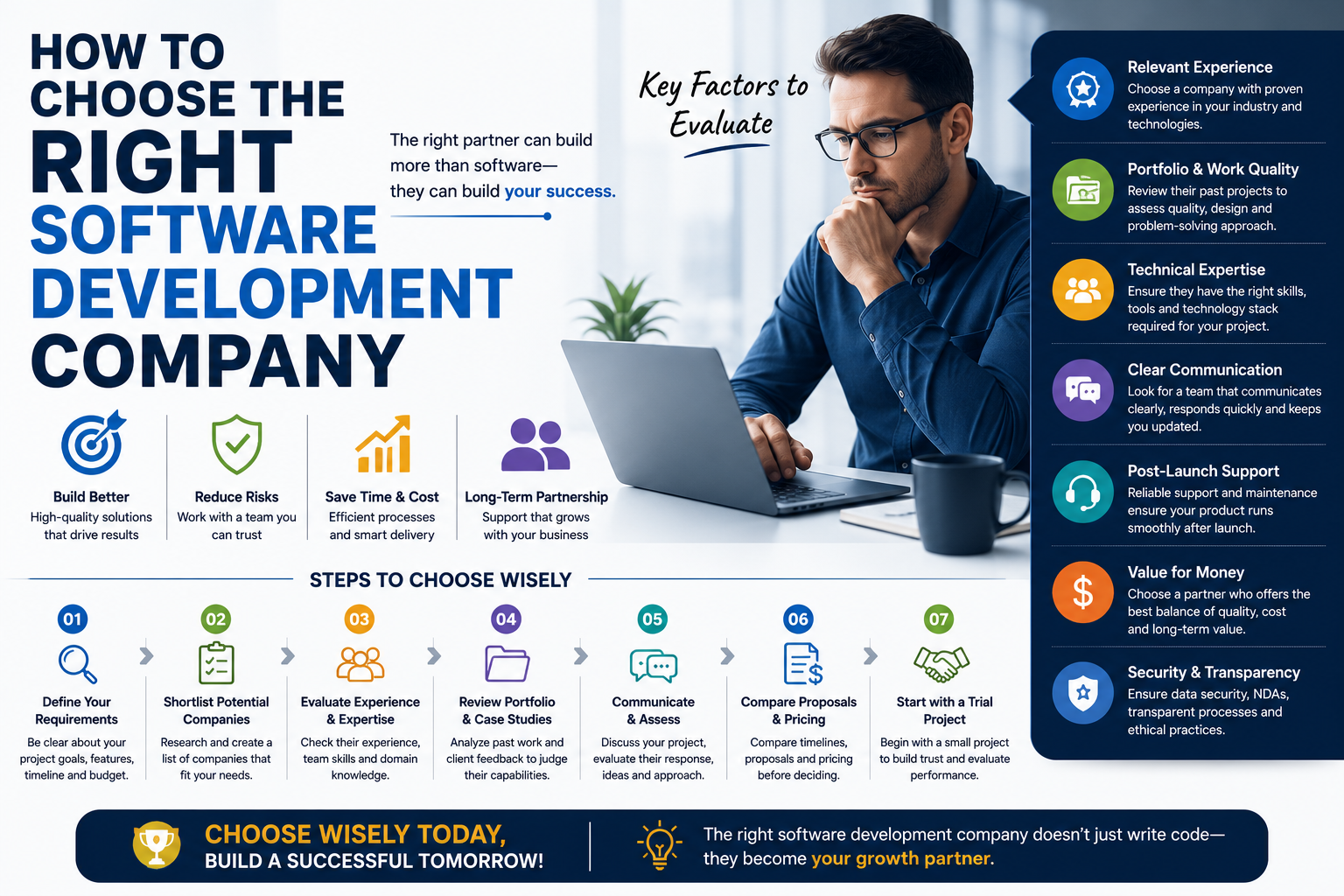
How to Choose the Right Software Development Company?
Choosing the right technology partner is one of the most important business decisions an organization can make. Whether you are a startup building your first Minimum Viable Product (MVP), an SME automating operations, or a large enterprise planning digital transformation, knowing How to Choose the Right Software Development Company can determine the success or failure of your project.
Today, businesses rely on software for nearly every function—from customer engagement and sales to inventory management, healthcare workflows, financial reporting, and AI-powered automation. However, selecting the wrong software development company often leads to missed deadlines, budget overruns, poor-quality code, security vulnerabilities, and products that fail to meet business objectives.
The right software development partner does much more than write code. They understand your business goals, recommend the most suitable technologies, build scalable and secure solutions, and provide long-term support to help your organization grow.
If you're searching for a Software Development Company in India, the USA, the UK, Australia, or Dubai, this comprehensive guide will help you evaluate vendors, compare service providers, ask the right questions, and make an informed decision.
How do you choose the right software development company?
Choose a software development company by evaluating:
- Industry experience
- Technical expertise
- Portfolio and case studies
- Client reviews and testimonials
- Communication process
- Development methodology
- Security practices
- Project management approach
- Pricing transparency
- Post-launch support
- Scalability
- AI and emerging technology expertise
The ideal software development partner should understand your business goals, recommend the right technology stack, communicate clearly, and deliver secure, scalable, and maintainable software within your timeline and budget.
Why This Decision Matters More Than Ever
Digital transformation is no longer optional.
Organizations across every industry are investing heavily in software to improve efficiency, automate repetitive tasks, reduce operational costs, and create better customer experiences.
Businesses today are investing in:
- AI-powered applications
- SaaS platforms
- ERP systems
- CRM software
- Mobile applications
- Web applications
- Healthcare software
- E-commerce platforms
- FinTech solutions
- Real Estate software
- Business automation tools
However, software projects have become increasingly complex.
Modern applications often require expertise in:
- Artificial Intelligence
- Cloud Computing
- Cybersecurity
- DevOps
- APIs
- Microservices
- Mobile Development
- UI/UX Design
- Data Engineering
This is why choosing an experienced Custom Software Development Company has become a strategic business decision rather than simply hiring programmers.
The Growing Importance of Custom Software
Every business is unique.
Generic software may solve common problems, but it rarely aligns perfectly with your workflows, customer expectations, or long-term goals.
Custom software offers:
- Tailored business processes
- Better productivity
- Competitive advantage
- Higher security
- Easier integrations
- Improved scalability
- Lower long-term costs
- Enhanced customer experience
Instead of adapting your business to software, custom software adapts to your business.
The Biggest Problem Businesses Face
Many organizations select software vendors based solely on price.
Unfortunately, the cheapest proposal often becomes the most expensive mistake.
Common consequences include:
- Delayed delivery
- Hidden costs
- Poor communication
- Low-quality coding
- Lack of documentation
- Security vulnerabilities
- Frequent software bugs
- Scalability issues
- Vendor lock-in
- Expensive maintenance
A software project is not simply an expense—it is a long-term investment.
Choosing the wrong partner can negatively impact your business for years.
Signs You've Chosen the Wrong Software Development Company
Many warning signs appear early but are often ignored.
Watch out for companies that:
- Promise unrealistic delivery timelines
- Offer unusually low pricing
- Cannot explain their development process
- Have no verified client testimonials
- Lack technical documentation
- Do not discuss security
- Avoid signing NDAs
- Cannot provide case studies
- Have poor communication
- Do not offer post-launch support
These are common indicators of an inexperienced software development agency.
What Is a Software Development Company?
A Software Development Company is an organization that designs, develops, tests, deploys, and maintains software solutions for businesses.
Their services typically include:
- Business analysis
- Software consulting
- UI/UX design
- Web development
- Mobile application development
- Enterprise software development
- AI application development
- Cloud migration
- DevOps implementation
- Software testing
- Maintenance and support
- Product modernization
A reputable software development company acts as a technology partner rather than just a service provider.
Types of Software Development Companies
Understanding the different types of providers can help you choose the right fit for your project.
Company Type
Best For
Advantages
Considerations
Custom Software Development Company
Tailored business solutions
Fully customized software
Higher initial investment
Enterprise Software Development Company
Large organizations
Scalable and secure solutions
Longer implementation timeline
Software Development Agency
Small to medium projects
Cost-effective and flexible
Team size may vary
AI Software Development Company
AI-powered products
Machine learning and automation expertise
Specialized skills required
Web Application Development Company
Browser-based platforms
Cross-platform accessibility
Requires strong backend architecture
Mobile App Development Company
Android and iOS applications
Better mobile user experience
Platform-specific optimization needed
SaaS Product Development Company
Subscription-based software
Recurring revenue model
Requires ongoing updates
Product Engineering Company
Long-term product development
Innovation-focused
Suitable for product businesses
Who Needs a Software Development Company?
Custom software benefits organizations across industries.
Startups
- Build MVPs quickly
- Validate ideas
- Scale efficiently
- Reduce development risks
Small & Medium Businesses
- Automate operations
- Improve productivity
- Reduce manual work
- Integrate existing systems
Enterprises
- Digital transformation
- ERP modernization
- Cloud migration
- AI implementation
Healthcare Organizations
- Electronic Health Records
- Patient Portals
- Telemedicine
- HIPAA-compliant software
E-commerce Businesses
- Marketplace platforms
- Inventory management
- Payment gateways
- Customer analytics
Real Estate Companies
- Property management systems
- CRM solutions
- Virtual property tours
- Lead management platforms
Why Businesses Prefer Custom Software Development
Off-the-Shelf Software
Custom Software
Generic features
Built specifically for your business
Limited integrations
Unlimited integrations
Monthly licensing fees
Long-term ownership
Limited scalability
Designed for future growth
Vendor-controlled updates
Full control over updates
Shared infrastructure
Higher security options
Standard workflows
Personalized workflows
15 Key Factors for Choosing the Right Software Development Company
1. Understand Your Business Goals
Before contacting any vendor, clearly define:
- Business objectives
- Target audience
- Expected outcomes
- Budget
- Timeline
- Must-have features
- Future expansion plans
A company can only recommend the right solution when your business objectives are clearly documented.
Expert Tip: Create a Software Requirements Specification (SRS) before requesting proposals.
2. Evaluate Industry Experience
Not every software company specializes in every industry.
Look for experience in:
- Healthcare
- FinTech
- Manufacturing
- Retail
- Logistics
- Education
- Real Estate
- E-commerce
- SaaS
- Government
Industry expertise significantly reduces project risks because experienced teams already understand compliance requirements, user expectations, and common challenges.
3. Assess Technical Expertise
Technology evolves rapidly.
Your development partner should demonstrate expertise in modern technologies such as:
Frontend
- React
- Angular
- Vue.js
- Next.js
Backend
- .NET
- Node.js
- Java
- Python
- PHP
- Go
Mobile
- Flutter
- React Native
- Swift
- Kotlin
Databases
- PostgreSQL
- MySQL
- MongoDB
- SQL Server
Cloud Platforms
- AWS
- Microsoft Azure
- Google Cloud Platform
Emerging Technologies
- Artificial Intelligence
- Machine Learning
- Blockchain
- IoT
- AR/VR
- Generative AI
- Computer Vision
Choose a software development company that recommends technology based on your business needs rather than simply using the tools they know best.
4. Review Their Portfolio Carefully
A portfolio reveals far more than attractive screenshots.
Evaluate:
- Project complexity
- Industries served
- Technology stack
- User experience
- Performance
- Scalability
- Innovation
- Business impact
Ask for live product demonstrations whenever possible.
5. Verify Client Reviews and Testimonials
Client feedback provides valuable insight into a company's reliability.
Look for evidence of:
- Timely delivery
- Communication quality
- Technical expertise
- Problem-solving ability
- Long-term support
- Customer satisfaction
Also pay attention to repeat clients, as they often indicate consistent performance and trust.
6. Understand Their Software Development Process
A professional Software Development Company should have a well-defined development lifecycle that ensures transparency, quality, and predictable delivery.
A Typical Software Development Process
Phase
Purpose
Deliverables
Discovery
Understand business requirements
Requirement Specification
Planning
Define scope, budget, and timeline
Project Plan
UI/UX Design
Create intuitive user experiences
Wireframes & Prototypes
Development
Build frontend and backend
Working Software
Testing
Ensure quality and security
QA Reports
Deployment
Launch the application
Live Product
Maintenance
Ongoing updates and support
Feature Enhancements & Bug Fixes
Expert Tip: Ask whether the company follows Agile, Scrum, Kanban, or Waterfall methodologies. Agile is generally the preferred approach for projects that require flexibility and continuous improvement.
7. Evaluate Their Communication Process
Communication is often the deciding factor in project success.
Ask questions such as:
- Who will be my primary point of contact?
- How frequently will project updates be shared?
- Which collaboration tools do you use?
- How are change requests managed?
- What happens if timelines shift?
Best Communication Tools
- Microsoft Teams
- Slack
- Jira
- Trello
- ClickUp
- Asana
- Azure DevOps
A reliable Software Development Partner provides proactive communication rather than waiting for the client to request updates.
8. Review Security and Compliance Standards
Security should be integrated into every stage of the development process—not added later.
Essential Security Practices
- Secure coding standards
- Role-based access control
- Data encryption
- Multi-factor authentication
- Regular vulnerability assessments
- Penetration testing
- Secure API development
- Backup and disaster recovery planning
Industry Compliance Examples
Industry
Common Compliance Standards
Healthcare
HIPAA
Finance
PCI DSS
Europe
GDPR
Australia
Australian Privacy Act
Healthcare Devices
FDA Guidance
Enterprise
ISO 27001
Businesses handling sensitive customer information should prioritize companies with proven security expertise.
9. Assess Scalability and Future Readiness
Your software should support business growth over the coming years.
Evaluate whether the proposed solution can:
- Handle increased traffic
- Support additional users
- Integrate with third-party systems
- Expand into multiple regions
- Support multilingual functionality
- Accommodate AI features in the future
Choosing a scalable architecture reduces future redevelopment costs.
10. Understand Their Quality Assurance Process
Software quality goes beyond fixing bugs.
A mature QA process includes:
- Manual testing
- Automated testing
- Functional testing
- Regression testing
- Performance testing
- Load testing
- Security testing
- User Acceptance Testing (UAT)
Ask if testing begins during development rather than only after coding is complete.
11. Evaluate Post-Launch Support
Launching software is only the beginning.
A dependable Software Development Firm should provide:
- Bug fixes
- Performance monitoring
- Security patches
- Feature enhancements
- Version upgrades
- Cloud monitoring
- Database optimization
- Technical support
Questions to Ask
- What does your maintenance package include?
- What are your response times?
- Do you provide 24/7 support?
- How are emergency issues handled?
12. Review Team Composition
A successful software project involves more than developers.
An experienced team typically includes:
- Business Analyst
- Solution Architect
- UI/UX Designer
- Frontend Developer
- Backend Developer
- Mobile Developer
- QA Engineer
- DevOps Engineer
- Project Manager
- Security Specialist
Understanding who will work on your project helps set realistic expectations.
13. Compare Pricing Models
Price should never be the sole deciding factor.
Common Engagement Models
Pricing Model
Best For
Advantages
Considerations
Fixed Price
Small projects with clear requirements
Predictable budget
Less flexibility
Time & Material
Evolving projects
Flexible scope
Variable cost
Dedicated Team
Long-term development
Full control and scalability
Requires ongoing management
Each model has its place depending on project complexity and business goals.
14. Assess Innovation and AI Capabilities
Businesses increasingly expect software partners to deliver innovative solutions.
Look for expertise in:
- Artificial Intelligence
- Machine Learning
- Predictive Analytics
- Intelligent Automation
- Generative AI
- Chatbots
- Computer Vision
- Natural Language Processing (NLP)
An AI Software Development Company can help future-proof your investment by incorporating intelligent features where they add measurable value.
15. Check Long-Term Partnership Potential
A software project often evolves over several years.
Consider whether the company demonstrates:
- Strategic thinking
- Industry knowledge
- Business consulting capabilities
- Transparent communication
- Continuous improvement
- Ongoing product roadmap support
The best software companies become trusted advisors rather than one-time vendors.
Software Development Company Checklist for Businesses
Before signing a contract, confirm that the vendor can answer "Yes" to the following:
- Understands your business objectives
- Has relevant industry experience
- Provides detailed project documentation
- Uses modern technology stacks
- Follows Agile development practices
- Offers transparent pricing
- Has verified client testimonials
- Implements secure coding practices
- Provides ongoing maintenance and support
- Can scale with your business
- Assigns a dedicated project manager
- Uses project management tools
- Signs an NDA if required
- Defines clear Service Level Agreements (SLAs)
- Shares ownership and intellectual property terms
Completing this checklist reduces the likelihood of costly surprises later in the project.
Questions to Ask Before Hiring a Software Development Company
Prepare these questions during your evaluation process:
- What experience do you have in my industry?
- Can you share relevant case studies?
- Which technologies do you recommend, and why?
- Who will work on my project?
- How do you estimate timelines?
- How do you manage scope changes?
- What testing practices do you follow?
- How do you ensure software security?
- What post-launch support do you provide?
- How is intellectual property ownership handled?
- Can you integrate with our existing systems?
- What risks do you foresee for this project?
- How do you handle communication across time zones?
- What metrics do you use to measure project success?
- What happens if key team members become unavailable?
These questions help evaluate both technical capability and operational maturity.
How to Compare Software Development Companies
When comparing vendors, avoid focusing solely on hourly rates.
Comparison Factor
Why It Matters
Business Understanding
Ensures solutions align with goals
Technical Capability
Supports reliable implementation
Industry Knowledge
Reduces project risk
Security Practices
Protects sensitive data
Communication
Keeps projects on track
Development Methodology
Improves flexibility and quality
Long-Term Support
Ensures software remains effective
Innovation
Enables future growth
A balanced comparison provides a more accurate picture of long-term value than price alone.
Software Development Cost: What Influences Pricing?
The cost of custom software development depends on several variables.
Major Cost Drivers
- Project complexity
- Number of features
- User roles and permissions
- Third-party integrations
- Mobile and web platform requirements
- UI/UX complexity
- Security requirements
- Compliance needs
- Testing effort
- Maintenance expectations
Typical Project Categories
Project Type
Relative Cost
Basic Business Website
Low
CRM or ERP System
Medium to High
SaaS Platform
High
AI-Powered Application
High
Enterprise Digital Transformation
Very High
Request detailed proposals that explain scope, assumptions, timelines, and deliverables to avoid hidden costs.
Offshore vs. Nearshore vs. Onshore Development
Model
Description
Best For
Onshore
Vendor located in the same country
High collaboration and regulatory alignment
Nearshore
Vendor in a nearby country
Similar time zones with potential cost savings
Offshore
Vendor in a different region
Cost efficiency and access to larger talent pools
For many global organizations, an experienced Offshore Software Development Company in India offers an effective balance of technical expertise, scalability, and competitive pricing.
Dedicated Team vs. Fixed Price vs. Time & Material
Engagement Model
Best For
Flexibility
Budget Predictability
Fixed Price
Clearly defined scope
Low
High
Time & Material
Evolving requirements
High
Medium
Dedicated Team
Long-term product development
Very High
Medium
Selecting the right engagement model depends on your project's complexity, timeline, and expected changes.
Expert Recommendations
- Define business objectives before approaching vendors.
- Prioritize proven expertise over the lowest bid.
- Evaluate communication, security, and long-term support alongside technical skills.
- Use a structured scoring matrix and checklist to compare providers consistently.
- Choose a partner that demonstrates innovation, scalability, and a commitment to long-term collaboration.
Understanding the Software Development Process
A structured software development process minimizes risks, improves collaboration, and ensures the final product aligns with business objectives. Professional software development companies typically follow an Agile Software Development Lifecycle (SDLC) with iterative planning, development, testing, and deployment.
H3: Phase 1 – Discovery & Business Analysis
Every successful project starts with understanding the business problem rather than immediately writing code.
Activities
- Stakeholder interviews
- Requirement gathering
- Business process analysis
- Competitor research
- User persona creation
- Technical feasibility assessment
- Risk identification
- Budget planning
Deliverables
- Software Requirement Specification (SRS)
- Product roadmap
- Scope document
- Project timeline
- Cost estimation
- Technical recommendations
Expert Insight: Investing time in discovery can significantly reduce costly changes later in the project.
Phase 2 – Solution Architecture
The solution architecture defines how the application will be structured to meet current and future business needs.
Architecture Considerations
- Scalability
- Security
- Performance
- Maintainability
- Integration capabilities
- Cloud readiness
- Disaster recovery
- High availability
A well-designed architecture ensures the software remains reliable as your business grows.
Phase 3 – UI/UX Design
Exceptional software is not only functional but also easy to use.
Design Deliverables
- User journey mapping
- Wireframes
- Interactive prototypes
- Design system
- Responsive layouts
- Accessibility considerations
Why UI/UX Matters
- Higher user adoption
- Reduced training requirements
- Increased productivity
- Better customer satisfaction
- Lower support costs
Phase 4 – Software Development
Development transforms approved designs into a working application.
Frontend Development
Technologies may include:
- React
- Angular
- Vue.js
- Next.js
Backend Development
Common technologies include:
- .NET
- Node.js
- Java
- Python
- PHP
- Go
Mobile Development
- Flutter
- React Native
- Swift
- Kotlin
Cloud Platforms
- AWS
- Microsoft Azure
- Google Cloud Platform
Professional teams use coding standards, version control, code reviews, and continuous integration throughout this phase.
Phase 5 – Quality Assurance & Testing]
Testing ensures the application performs as expected under real-world conditions.
Testing Types
Testing Type
Purpose
Functional Testing
Verify features work correctly
Regression Testing
Ensure updates don't break existing functionality
Performance Testing
Measure speed and responsiveness
Load Testing
Simulate high user traffic
Security Testing
Identify vulnerabilities
Compatibility Testing
Validate across browsers and devices
User Acceptance Testing
Confirm business requirements are met
A strong QA process improves reliability and reduces production issues.
Phase 6 – Deployment
After successful testing, the application is prepared for release.
Deployment Checklist
- Production environment setup
- Database migration
- Security validation
- Backup creation
- Monitoring tools configuration
- Performance optimization
- Final smoke testing
Many companies use CI/CD pipelines to automate deployments, reducing manual errors and enabling faster releases.
Phase 7 – Maintenance & Continuous Improvement
Software requires ongoing attention after launch.
Typical Maintenance Activities
- Bug fixes
- Security updates
- Performance optimization
- Feature enhancements
- API upgrades
- Infrastructure monitoring
- User feedback implementation
The most successful software products evolve continuously based on user needs and business priorities.
H2: Industry-Specific Recommendations
Different industries have unique operational, regulatory, and technical requirements. Choosing a software development partner with relevant domain experience can reduce risk and accelerate delivery.
H3: Software Development Company for Startups
Startups need speed, flexibility, and cost efficiency.
Priorities
- Rapid MVP development
- Agile iterations
- Scalable architecture
- Investor-ready products
- Cloud-native infrastructure
- Cost optimization
Recommended Services
- Product strategy
- UI/UX design
- Web and mobile app development
- MVP development
- SaaS platform development
- API integrations
Best Custom Software Development Company for SMEs
Small and medium-sized businesses often seek automation and operational efficiency.
Common Solutions
- CRM systems
- Inventory management
- HR management
- Accounting integrations
- Workflow automation
- Customer portals
Key Benefits
- Reduced manual processes
- Improved productivity
- Better reporting
- Enhanced customer experience
Enterprise Software Development Company
Large enterprises require scalable, secure, and integrated solutions.
Enterprise Priorities
- ERP modernization
- Digital transformation
- Multi-location support
- Identity and access management
- Data governance
- Compliance
- High availability
- Business intelligence
Enterprise projects benefit from experienced architects, mature project governance, and strong change management practices.
Software Development Company for Healthcare
Healthcare software must balance usability, security, and regulatory compliance.
Typical Solutions
- Electronic Health Records (EHR)
- Telemedicine platforms
- Hospital Management Systems
- Appointment scheduling
- Patient portals
- Laboratory Information Systems
- Medical billing
- Health analytics
Important Considerations
- Data privacy
- Secure access controls
- Audit trails
- Interoperability
- Regulatory compliance
- Reliable uptime
Software Development Company for Real Estate
Real estate businesses increasingly rely on digital platforms to streamline operations and improve customer engagement.
Popular Applications
- Property listing portals
- CRM systems
- Virtual property tours
- Lead management
- Document management
- Rental management
- Broker dashboards
- Mobile applications
Business Benefits
- Faster lead response
- Better client communication
- Increased sales productivity
- Centralized property management
Software Development Company for eCommerce Businesses
Modern eCommerce businesses require more than an online storefront.
Common Features
- Product catalog management
- Shopping cart
- Secure payment gateways
- Inventory synchronization
- Order tracking
- Customer loyalty programs
- Recommendation engines
- Analytics dashboards
Growth Opportunities
- AI-powered recommendations
- Personalized shopping experiences
- Omnichannel integration
- Marketing automation
AI in Modern Software Development
Artificial Intelligence is reshaping software products and development workflows.
Practical AI Use Cases
- Intelligent chatbots
- Document processing
- Fraud detection
- Predictive analytics
- Recommendation engines
- Image recognition
- Voice assistants
- Process automation
- Customer sentiment analysis
When evaluating a software development partner, ask about their experience integrating AI responsibly and securely into business applications.
H2: Mini Case Study Examples
These examples illustrate common scenarios and outcomes. They are intended as representative use cases rather than specific client engagements.
Case Study 1: Startup SaaS Platform
Challenge
A startup needed to launch a subscription-based SaaS product within six months to validate market demand.
Solution
- Discovery workshop
- MVP development
- Cloud-native architecture
- Agile delivery
- CI/CD implementation
Outcome
- Faster product launch
- Early customer feedback
- Simplified feature prioritization
- Foundation for future scaling
Case Study 2: Healthcare Digital Transformation
Challenge
A healthcare provider relied on fragmented manual processes that slowed patient services.
Solution
- Patient portal
- Appointment scheduling
- Secure document management
- Workflow automation
Outcome
- Improved operational efficiency
- Better patient experience
- Reduced administrative workload
- Stronger data visibility
Case Study 3: eCommerce Modernization
Challenge
An online retailer experienced cart abandonment and inconsistent inventory management.
Solution
- Responsive web platform
- Inventory synchronization
- Payment integration
- Personalized recommendations
Outcome
- Improved customer experience
- More accurate inventory visibility
- Streamlined order processing
- Better scalability during peak demand
Common Mistakes Businesses Make
Many software projects encounter avoidable challenges due to planning and vendor selection mistakes.
1. Choosing the Lowest Bid
Low-cost proposals may exclude important activities such as testing, documentation, security, or post-launch support.
2. Undefined Project Requirements
Unclear objectives often lead to scope changes, delays, and budget increases.
3. Ignoring Scalability
Software designed only for current needs may require expensive redevelopment as the business grows.
4. Underestimating Security
Delaying security considerations can expose organizations to compliance issues and cyber threats.
5. Focusing Only on Technical Skills
A technically capable team must also communicate effectively, understand business goals, and collaborate throughout the project.
6. Skipping Due Diligence
Failing to review portfolios, client references, and development practices increases project risk.
7. Neglecting Post-Launch Support
Software requires ongoing maintenance, updates, and enhancements to remain secure and effective.
H2: Best Practices for Choosing a Software Development Company
Follow these proven recommendations to improve project outcomes.
Planning
- Define measurable business goals.
- Document functional and technical requirements.
- Identify success metrics.
Vendor Evaluation
- Review relevant industry experience.
- Assess technical expertise.
- Verify client references.
- Evaluate communication practices.
Project Execution
- Adopt Agile methodologies where appropriate.
- Conduct regular progress reviews.
- Prioritize quality assurance.
- Maintain transparent documentation.
Technology
- Select scalable architectures.
- Design with security in mind.
- Use cloud-native services when appropriate.
- Plan for future integrations and AI capabilities.
Partnership
- Build long-term relationships.
- Encourage continuous feedback.
- Review performance against agreed KPIs.
- Invest in ongoing product improvements.
Expert Opinion
Organizations should view software development as a strategic business investment rather than a one-time technical project. The strongest outcomes are achieved when technology decisions are driven by business objectives, supported by experienced multidisciplinary teams, and validated through iterative delivery and continuous improvement.
Software Development Trends to Watch in 2026 and Beyond
Technology continues to evolve rapidly, and businesses should choose a software development partner that can adapt to future demands rather than only meeting today's requirements.
1. AI-First Software Development
Artificial Intelligence is becoming a standard capability in modern business applications.
Common AI Integrations
- AI chatbots
- Virtual assistants
- Predictive analytics
- Intelligent search
- Document automation
- Customer behavior analysis
- Personalized recommendations
- Workflow automation
Organizations should evaluate whether a software development company has practical experience implementing AI where it delivers measurable business value.
2. Cloud-Native Development
Cloud-native applications offer:
- Improved scalability
- Faster deployment
- Better disaster recovery
- Lower infrastructure management
- Enhanced reliability
Technologies such as Kubernetes, Docker, and serverless computing continue to gain adoption.
3. Cybersecurity by Design
Security is now an essential part of software architecture.
Modern applications should incorporate:
- Zero Trust principles
- Secure authentication
- Encryption
- Continuous monitoring
- Vulnerability scanning
- Compliance controls
4. Low-Code and No-Code Platforms
Low-code solutions accelerate internal business application development.
Best suited for:
- Internal workflows
- Approval systems
- Dashboards
- Reporting tools
Mission-critical or highly customized systems still benefit from traditional custom software development.
H3: 5. DevSecOps
Security is increasingly integrated into continuous development pipelines.
Benefits include:
- Faster releases
- Early vulnerability detection
- Improved software quality
- Better compliance
6. API-First Architecture
Businesses rely on integrations with payment gateways, CRMs, ERPs, marketing tools, and third-party services.
API-first development simplifies future integrations and enhances scalability.
7. Data-Driven Decision Making
Modern software should provide actionable insights through:
- Business intelligence dashboards
- Real-time reporting
- Predictive analytics
- KPI tracking
- Automated alerts
8. Sustainable Software Engineering
Organizations are placing greater emphasis on:
- Efficient infrastructure utilization
- Optimized code performance
- Reduced cloud resource consumption
- Environmentally responsible computing practices
Expert Recommendations Before Hiring a Software Development Company
Before making your final decision, ensure the company can demonstrate:
- Relevant industry expertise
- Modern technology capabilities
- Transparent communication
- Strong project governance
- Proven security practices
- Scalable architecture
- Long-term support
- Innovation and AI readiness
- Clear documentation
- Measurable business outcomes
Think beyond the initial project. The ideal software development company becomes a strategic technology partner that supports your organization's growth over time.
Frequently Asked Questions (FAQs)
1. How do I choose the right software development company?
Define your business objectives, evaluate technical expertise, review industry experience, assess communication processes, verify client references, compare pricing models, and ensure the company offers long-term maintenance and support.
2. What should I look for in a software development company?
Look for proven experience, a strong portfolio, skilled developers, transparent project management, robust security practices, scalable solutions, and positive client feedback.
3. How much does custom software development cost?
The cost depends on factors such as project complexity, features, integrations, compliance requirements, team size, and development timeline. Request a detailed proposal rather than relying on hourly rates alone.
4. How long does software development usually take?
Timelines vary depending on project scope. Smaller projects may take a few months, while enterprise platforms or AI-enabled systems can require significantly longer. A phased delivery approach often helps businesses realize value sooner.
5. Should I choose an offshore software development company?
Offshore development can provide access to specialized talent and cost efficiencies. Evaluate communication practices, security standards, project management processes, and relevant experience before making a decision.
6. Why is Agile development recommended?
Agile enables iterative delivery, continuous feedback, faster adaptation to changing requirements, and improved collaboration between stakeholders and development teams.
7. What questions should I ask before hiring software developers?
Ask about industry expertise, technology stack, security practices, testing methodology, maintenance plans, communication processes, team structure, and previous project outcomes.
8. What is the difference between custom software and off-the-shelf software?
Custom software is designed specifically for your organization's requirements, while off-the-shelf software offers standardized functionality intended for a broad audience.
9. How important is post-launch support?
Ongoing support is essential for bug fixes, security updates, performance improvements, and feature enhancements that keep the software aligned with evolving business needs.
10. What technologies should a modern software development company support?
A capable partner should have expertise in web and mobile development, cloud platforms, APIs, cybersecurity, DevOps, AI, and modern frontend and backend technologies.
11. How can I compare software development companies effectively?
Use a weighted evaluation matrix that considers experience, technical expertise, communication, security, portfolio quality, scalability, support services, and overall value rather than price alone.
12. Is custom software worth the investment?
For businesses with unique processes, growth plans, or integration needs, custom software can deliver greater efficiency, flexibility, and long-term value than generic solutions.
13. Why is security important in software development?
Strong security practices protect sensitive data, reduce operational risk, support regulatory compliance, and strengthen customer trust.
14. Can a software development company help with digital transformation?
Yes. Many firms provide consulting, process analysis, system modernization, cloud migration, automation, and integration services as part of broader digital transformation initiatives.
15. What industries benefit most from custom software development?
Healthcare, finance, manufacturing, logistics, retail, education, real estate, eCommerce, professional services, and startups all benefit from solutions tailored to their operational requirements.
Choosing the right software development company is more than selecting a vendor—it is choosing a long-term technology partner that can help your organization innovate, scale, and compete effectively.
The most successful projects begin with clear business goals, thorough vendor evaluation, transparent communication, secure architecture, and a commitment to continuous improvement. Whether you are a startup building your first product, an SME automating operations, or an enterprise pursuing digital transformation, investing time in selecting the right partner can significantly improve project outcomes.
Rather than focusing solely on cost, evaluate expertise, delivery capabilities, security practices, and the ability to support your business over the long term.
Looking for a trusted Software Development Company to turn your ideas into scalable digital solutions?
TGAYS Technology delivers custom software development, AI-powered applications, web development, mobile app development, enterprise solutions, cloud consulting, and digital transformation services for businesses worldwide.
Whether you're based in India, the USA, the UK, Australia, or Dubai, our experienced team can help you:
- Build custom software tailored to your business
- Modernize legacy systems
- Develop secure web and mobile applications
- Integrate AI and automation into business workflows
- Scale your technology infrastructure
- Accelerate digital transformation initiatives
Ready to discuss your project? Contact TGAYS Technology for a personalized consultation and discover how the right technology strategy can support your business goals.
Summary
Choosing the right software development company requires more than comparing prices. Businesses should evaluate technical expertise, industry experience, development methodologies, communication practices, security standards, scalability, and long-term support. A structured selection process, supported by clear requirements and objective evaluation criteria, helps organizations identify a technology partner capable of delivering secure, scalable, and future-ready software solutions.