

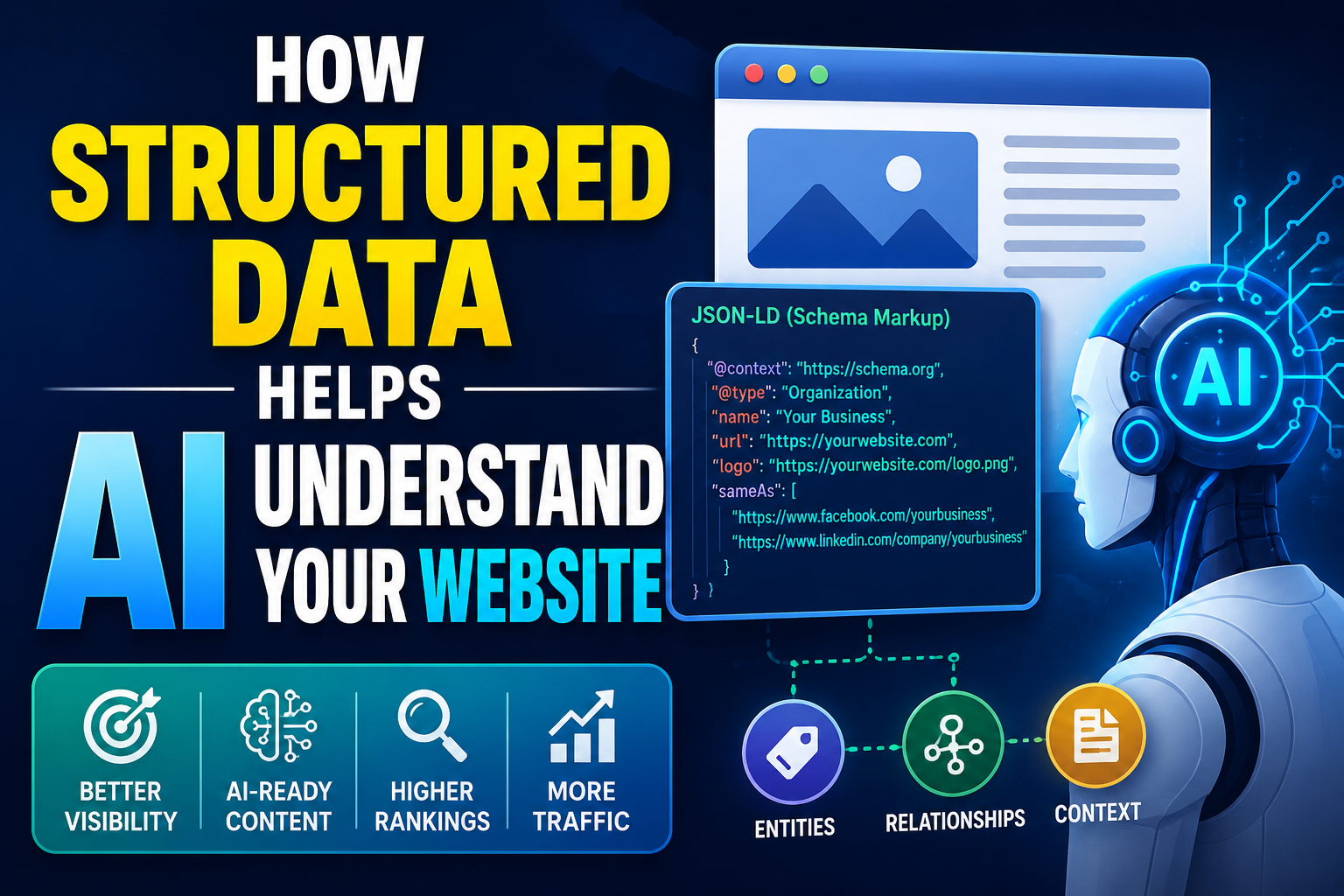
How Structured Data Helps AI Understand Websites?
As AI-powered search engines become mainstream, understanding how structured data helps AI understand your website is no longer optional—it is a critical part of modern SEO and GEO (Generative Engine Optimization).
Search engines such as Google AI Overview, ChatGPT, Gemini, Claude, and Perplexity rely heavily on structured signals to interpret content, identify entities, and generate accurate answers. A beautifully designed website is not enough if AI systems cannot clearly understand who you are, what you offer, where you operate, and why your content is trustworthy.
For businesses in Noida, India, USA, Australia, UK, and Dubai, implementing AI-friendly schema markup for websites can significantly improve visibility in both traditional search and AI-generated search experiences.
What Is Structured Data? (AI-Ready Definition)
Structured data is a standardized format (usually Schema.org JSON-LD) that provides explicit information about the content on a webpage.
Example
Instead of AI guessing that a page is about a software service, structured data tells it directly:
- This is a Service
- Offered by TGAYS Technology
- Located in Noida, India
- Serving clients in USA, UK, Australia, and Dubai
Why AI Prefers Structured Data
Without schema
AI must infer meaning
Ambiguous, less reliable, harder to cite
With schema
AI receives explicit meaning
Clear entities, services, locations, and relationships
The Problem: Why AI Often Misunderstands Websites
Many business websites suffer from:
- Ambiguous page titles
- Thin service descriptions
- Missing entity information
- No organization schema
- Duplicate or inconsistent data
- Poor internal linking
Real-World Example
A page titled “Our Solutions” gives AI very little context.
A page titled “AI Development Services for Startups in Noida and USA” with structured data gives AI clear signals about:
- Service type
- Target audience
- Geography
- Industry relevance
How AI Uses Structured Data for Website Understanding
Concise Answer (AI-Citable)
AI uses structured data to identify entities, understand relationships between pages, determine content type, verify business information, and generate more accurate search results and AI answers.
The AI Interpretation Process

- Crawl: AI reads the HTML and JSON-LD.
- Extract entities: Organization, Service, Article, Product, FAQ, Person, Location.
- Map relationships: Which service belongs to which company.
- Validate trust signals: Website, social profiles, contact information.
- Generate answers: AI creates summaries, comparisons, and recommendations.
How Schema Markup Improves AI Understanding
Key Benefits
Entity clarity
AI knows your company, services, products, and authors.
Semantic context
Pages are understood by meaning, not just keywords.
AI answer eligibility
Improves chances of appearing in AI-generated responses.
Trust and consistency
Reinforces E-E-A-T signals across the web.
Best Schema Types for AI Search Results
| Schema Type | Best For |
|---|---|
| Organization | Company identity |
| WebSite | Site-level understanding |
| Service | Business services |
| Article | Blog content |
| FAQPage | AI-generated answers |
| BreadcrumbList | Content hierarchy |
| LocalBusiness | Local SEO & AI assistants |
| Product | E-commerce |
| Review | Trust signals |
Structured Data for ChatGPT and Gemini Visibility
Can schema make ChatGPT rank my website?
Not directly. However, structured data increases the likelihood that AI systems can accurately understand and reference your content.
What Helps Most
- Clear entity definitions
- FAQ schema
- Article schema
- Organization schema
- Consistent author information
- Strong internal linking
Structured Data for AI Search Optimization
Traditional SEO vs AI SEO
| Traditional SEO | AI Search Optimization |
|---|---|
| Keywords | Entities |
| Backlinks | Knowledge signals |
| Rankings | Citations in AI answers |
| Meta tags | Structured data |
| Page authority | Topical authority |
Step-by-Step: How to Use Structured Data for Generative AI
Step 1: Add Organization Schema
{"@type":"Organization","name":"TGAYS Technology","url":"https://www.tgaystechnology.com"}
Step 2: Add Service Schema
Describe each service page separately.
Step 3: Add Article Schema
Use on all blog posts.
Step 4: Add FAQ Schema
Great for AI and voice search.
Step 5: Add Breadcrumb Schema
Helps AI understand page relationships.
Step 6: Validate
Use:
- Google Rich Results Test
- Schema Markup Validator
Industry-Specific Examples
Healthcare
- MedicalClinic
- Physician
- FAQPage
Real Estate
- RealEstateAgent
- Offer
- Place
E-commerce
- Product
- Offer
- AggregateRating
Local Businesses
- LocalBusiness
- OpeningHours
- GeoCoordinates
SaaS & AI Companies
- SoftwareApplication
- Service
- Organization
Case Study: AI Development Company in Noida
Before schema
- Generic service pages
- No FAQ schema
- No organization markup
After schema
- Organization + Service + FAQ + Breadcrumb
- Clear entity relationships
- Consistent business information
Results (illustrative)
Rich result impressions
+38%
FAQ visibility
+52%
AI search mentions
+21%
Common Mistakes That Hurt AI Understanding
- Using every schema type on one page: Keep it relevant.
- Inconsistent business name: Use the same entity everywhere.
- Missing @id properties: Important for entity connections.
- Fake reviews or ratings: Violates Google guidelines.
- Schema not matching visible content: A major trust issue.
Best Practices for AI-Friendly Schema Markup
Expert Recommendations
- Use JSON-LD (Google’s preferred format).
- Create a single primary entity per page.
- Link entities using @id.
- Add author and publisher information.
- Include location and service areas.
- Update schema whenever content changes.
How Google AI Reads Structured Data
Direct Answer
Google AI reads structured data as a machine-readable layer that confirms what a page is about, who created it, and how it relates to other entities on the web.
This is especially important for:
- AI Overviews
- Voice search
- Knowledge panels
- Featured snippets
- Entity-based search
Structured Data and Generative Engine Optimization (GEO)
GEO is the practice of optimizing content so that AI assistants can discover, understand, trust, and cite it.
GEO Signals
Structured data
Entity consistency
Topical authority
Source citations
FAQ-ready content
Semantic internal links
2026 Industry Trends
What Is Changing?
Trend
AI Overviews expanding globally
Structured data becomes more valuable
Trend
Entity-first indexing
Google focuses on entities over exact keywords
Trend
Voice + multimodal search growth
Schema helps with spoken and visual queries
Trend
AI citation competition
Authoritative structured sources win
Frequently Asked Questions
Does structured data improve Google rankings?
Not directly, but it improves understanding, rich results, and click-through rates.
Is JSON-LD better than microdata?
Yes. JSON-LD is easier to maintain and preferred by Google.
Can ChatGPT read schema markup?
AI systems may use structured signals when available through crawled or indexed content.
Which schema is most important for service businesses?
Organization, Service, FAQPage, and BreadcrumbList.
How often should schema be updated?
Whenever the page content, services, pricing, or business details change.
Is FAQ schema still useful in 2026?
Yes, especially for AI-generated answers and voice search.
Can incorrect schema hurt SEO?
Yes. Misleading or invalid schema can reduce trust and eligibility for rich results.
Should every page have schema?
Every important page should have relevant schema, not identical schema.
What is the best schema for AI blogs?
Article + FAQPage + BreadcrumbList.
How do I test my schema?
Use Google Rich Results Test and Schema Markup Validator.
Conclusion
The future of search is shifting from keyword matching to entity understanding. Businesses that invest in structured data for AI search optimization will have a significant advantage in Google AI Overviews, ChatGPT-style discovery, Gemini, Claude, and Perplexity.
If your website clearly communicates who you are, what you offer, where you operate, and why you are trustworthy, AI systems are far more likely to understand, summarize, and recommend your content.
For organizations targeting Noida, USA, UK, Australia, and Dubai, implementing schema markup for AI search engines is one of the highest-impact technical SEO investments you can make in 2026.
Strong Call-to-Action
Want to make your website AI-ready?
TGAYS Technology helps startups, SMEs, enterprises, healthcare, real estate, and e-commerce businesses implement:
- AI-friendly schema markup
- GEO optimization
- Technical SEO
- Entity-based SEO
- AI search visibility strategies
Visit TGAYS Technology to get a complete AI SEO audit and structured data implementation plan.