

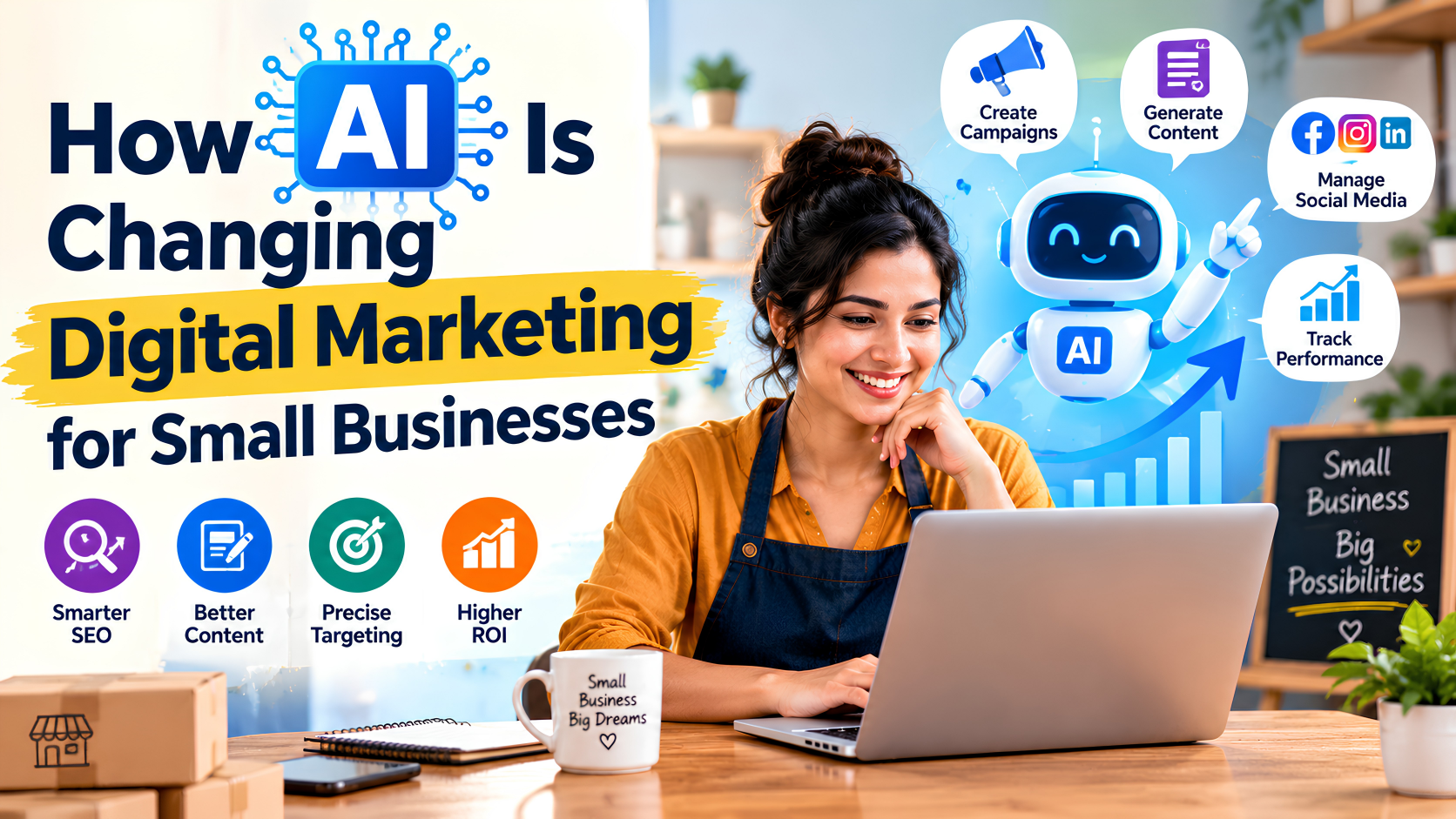
How AI Is Changing Digital Marketing for Small Businesses
AI for small business marketing is no longer simply about generating blog posts or writing social media captions. Artificial intelligence is changing how small businesses research customers, create content, optimize SEO, generate leads, personalize campaigns, analyze performance, and automate repetitive marketing activities.
For years, large enterprises had an advantage because they could afford bigger marketing teams, expensive software, data analysts, agencies, and specialized technology. AI is narrowing that gap.
A small business can now use AI-powered tools to perform tasks that previously required multiple specialists—while human marketers remain responsible for strategy, creativity, brand positioning, accuracy, and customer relationships.
The opportunity is significant. An OECD survey of more than 5,000 SMEs found that 31% were already using generative AI. Among SMEs using it, 65% reported improved employee performance, 35% reported increased ability to scale, 29% said it helped them compete with larger companies, and 26% reported increased revenue.
The real question is no longer “Should small businesses use AI?”
It is:
“How can small businesses use AI strategically without losing the human expertise that makes their marketing valuable?”
What Is AI for Small Business Marketing?
AI for small business marketing is the use of artificial intelligence to improve, automate, personalize, and analyze marketing activities such as SEO, content creation, advertising, social media, email marketing, lead generation, and customer engagement.
AI can assist with:
- Keyword and competitor research
- Content ideation and content briefs
- SEO optimization
- Customer segmentation
- Social media planning
- Email personalization
- Lead qualification
- Ad campaign analysis
- Marketing automation
- Customer-service chatbots
- Predictive analytics
- Reporting and performance analysis
- AI-assisted market research
However, AI should be treated as a marketing capability, not a replacement for marketing strategy.
Why AI Matters More to Small Businesses
Small businesses usually face three major marketing constraints:
- Limited resources
- Limited specialist expertise
- Limited time
AI can address all three.
| Traditional Challenge | AI-Assisted Opportunity |
|---|---|
| Limited marketing staff | AI-assisted workflows |
| Expensive content production | Faster content research and drafting |
| Manual reporting | Automated analysis |
| Slow lead follow-up | AI-assisted lead qualification |
| Limited SEO expertise | AI-supported keyword and content analysis |
| Generic campaigns | Customer segmentation and personalization |
| Repetitive tasks | Marketing automation |
| Limited data analysis | Faster insights from marketing data |
Microsoft's 2025 Work Trend Index found that 24% of SMBs were already using AI agents, while 79% planned to implement them within the following 12–18 months.
This points toward a major shift: small marketing teams are increasingly becoming human + AI teams.
How AI Is Changing Digital Marketing for Small Businesses
1. AI Is Transforming SEO
AI for SEO can accelerate many activities that traditionally consume hours of manual work.
AI can help marketers:
- Discover keyword clusters
- Identify search intent
- Analyze content gaps
- Generate content briefs
- Improve title and heading structures
- Identify internal-linking opportunities
- Analyze competitors
- Create FAQ ideas
- Develop topical maps
- Identify semantic entities and related concepts
But AI-generated content alone is not an SEO strategy.
Google states that its systems prioritize helpful, reliable, people-first content and warns against producing large amounts of automated content primarily to manipulate rankings.
Best approach: Use AI for research and efficiency, then add human expertise, original insights, first-hand experience, examples, data, opinions, and verification.
2. AI Is Changing Content Marketing
AI for content marketing allows small businesses to build a consistent publishing system without needing a large editorial department.
A single topic can become:
- Blog article
- LinkedIn post
- Instagram carousel
- Short video script
- Email newsletter
- FAQ section
- Sales-enablement content
- Customer education material
The competitive advantage, however, is not simply producing more content.
It is producing more useful content.
For example, instead of publishing:
“10 Benefits of Digital Marketing”
a local software company could publish:
“How a Noida SaaS Startup Can Generate Its First 100 Qualified Leads Using SEO, AI and LinkedIn”
The second topic demonstrates stronger audience understanding, specificity, and practical value.
3. AI Is Improving Lead Generation
AI for lead generation can help businesses identify, qualify, nurture, and prioritize prospects.
Examples include:
- AI chatbots
- Lead scoring
- Automated email sequences
- Website personalization
- CRM data analysis
- Intent detection
- Automated follow-ups
- Sales forecasting
Consider a real estate company.
Instead of manually responding to every website enquiry, an AI-assisted system can collect:
- Property preference
- Budget
- Location
- Purchase timeline
- Financing requirement
The system can then categorize the enquiry and route high-intent prospects to the sales team.
The result is not necessarily fewer human interactions—it is better allocation of human attention.
4. AI Is Changing Social Media Marketing
AI for social media marketing can help small businesses manage the entire content workflow.
It can assist with:
- Content calendars
- Post ideas
- Caption development
- Audience research
- Competitor analysis
- Video scripts
- Hashtag research
- Repurposing content
- Performance analysis
A small healthcare business, for example, could turn one expert article into:
1 blog → 5 LinkedIn posts → 3 short videos → 1 newsletter → 10 FAQs
Human review remains essential, particularly in healthcare, finance, legal, and other sensitive industries.
5. AI Is Making Marketing Personalization More Accessible
Enterprise companies have historically had sophisticated personalization systems.
AI is making personalization more accessible to SMEs.
Businesses can use AI to analyze customer behavior and create different messaging for:
- New visitors
- Returning customers
- Existing clients
- High-value prospects
- Abandoned-cart users
- Local customers
- Enterprise prospects
For e-commerce businesses, this can support personalized product recommendations, email campaigns, promotions, and customer journeys.
6. AI Is Improving Marketing Analytics
Marketing analytics often produces enormous amounts of data but not enough actionable insight.
AI for marketing analytics can help identify:
- Which channels generate qualified leads
- Which campaigns produce conversions
- Which keywords attract commercial traffic
- Which landing pages underperform
- Which customer segments generate higher revenue
- Where conversion rates are declining
- Which marketing activities deserve greater investment
The goal should be:
Data → Insight → Decision → Action
not simply:
Data → Dashboard
AI Marketing Automation: From Tasks to Workflows
One of the biggest opportunities is AI marketing automation.
Instead of automating isolated tasks, businesses should build connected workflows.
Example: Local Service Business
Step 1: Visitor arrives through Google.
Step 2: Website answers common questions using an AI-assisted chatbot.
Step 3: Visitor submits an enquiry.
Step 4: CRM records the lead.
Step 5: AI categorizes lead intent.
Step 6: Automated email/SMS follow-up begins.
Step 7: Sales representative receives a qualified lead.
Step 8: CRM records the outcome.
Step 9: Marketing analytics identifies the campaign and keyword responsible for the lead.
This creates a connected marketing system rather than a collection of disconnected AI tools.
How Small Businesses Can Use AI for Digital Marketing: A Practical Process
Step 1: Identify repetitive marketing tasks
Start with activities consuming significant time but requiring limited strategic judgment.
Step 2: Identify high-value opportunities
Prioritize tasks connected to:
- Revenue
- Lead generation
- Customer retention
- Conversion rate
- Marketing efficiency
Step 3: Select the right AI tools
Don't purchase dozens of AI tools.
Choose tools based on specific business problems.
Step 4: Build human review into the workflow
AI output should be checked for:
- Accuracy
- Brand voice
- Originality
- Compliance
- Customer relevance
- Factual claims
Step 5: Connect AI with business data
Where appropriate, connect AI workflows with:
- CRM
- Analytics
- Search Console
- Advertising platforms
- E-commerce systems
- Customer databases
Step 6: Measure business outcomes
Track:
Traffic → Leads → Qualified Leads → Sales → Revenue → Customer Lifetime Value
This prevents businesses from confusing AI activity with marketing success.
Benefits of AI in Digital Marketing for Small Businesses
The biggest potential benefits include:
- Lower marketing workload
- Faster content production
- Better customer targeting
- Faster data analysis
- Improved lead qualification
- Greater marketing consistency
- More personalized customer experiences
- Faster experimentation
- Better scalability
- Increased team productivity
Importantly, AI does not automatically create these benefits. They depend on implementation quality, data quality, human oversight, and business strategy.
Common Mistakes Small Businesses Should Avoid
1. Publishing generic AI content
AI-generated content without expertise, originality, or customer insight can make a website look interchangeable.
2. Using too many AI tools
Tool overload creates complexity instead of productivity.
3. Automating everything
Customer relationships, brand positioning, strategy, and sensitive communications still require human judgment.
4. Ignoring data privacy
Businesses must understand how AI platforms handle customer and company information.
5. Measuring AI activity instead of ROI
The number of AI-generated articles is not a business KPI.
6. Forgetting brand differentiation
If competitors use the same AI tools, identical prompts can produce remarkably similar marketing.
Your competitive advantage comes from your data, expertise, experience, positioning, and customer understanding.
Best Practices for AI Marketing for Small Businesses
Follow these principles:
- Start with business objectives, not AI tools.
- Automate repetitive tasks before strategic tasks.
- Keep humans responsible for important decisions.
- Use first-party customer data responsibly.
- Fact-check AI-generated claims.
- Add original experience and expert insight to content.
- Create reusable AI workflows instead of one-off prompts.
- Measure leads, conversions and revenue—not output volume.
- Regularly audit AI workflows for accuracy and quality.
- Keep content people-first.
Google's current guidance emphasizes original, helpful, reliable content created for people rather than content produced primarily to manipulate search rankings.
AI + GEO + AEO: The Next Marketing Opportunity
AI search is also changing how businesses need to structure information.
People increasingly ask conversational questions such as:
- “What is the best digital marketing strategy for a small business?”
- “How can a small business use AI to generate leads?”
- “Which AI tools are useful for local businesses?”
- “How can AI improve SEO for an SME?”
To increase the chance of being understood and referenced by AI systems, content should provide:
- Clear definitions
- Direct answers
- Question-based headings
- Original insights
- Structured information
- Relevant entities
- Specific examples
- Authoritative references
- Consistent business information
- Strong topical coverage
Google has specifically advised publishers to focus on unique, valuable content and ensure pages are accessible and provide a good user experience for AI search experiences.
Industry Trends to Watch
AI Agents
AI is moving from answering questions to executing multi-step workflows.
AI-Powered Search
Search increasingly involves conversational answers, summaries, recommendations, and follow-up questions.
Hyper-Personalization
Businesses will increasingly tailor marketing experiences according to customer intent and behavior.
Predictive Marketing
AI will increasingly help marketers identify likely customer actions before they happen.
Human-Agent Collaboration
Marketing teams will increasingly manage AI agents rather than performing every repetitive task themselves.
AI-Native SMEs
The most competitive small businesses may not simply be companies that “use AI.”
They will be businesses designed around AI-assisted workflows from the beginning.
Practical Case Study Examples
Example 1: Local Healthcare Business
Challenge: Limited marketing staff and inconsistent content.
AI approach: Keyword research, content briefs, FAQ generation, social-media repurposing and lead categorization.
Human role: Medical accuracy, expert review, patient trust and final publishing.
Potential outcome: More consistent marketing without proportionally increasing workload.
Example 2: E-commerce Business
Challenge: Hundreds of products and limited content resources.
AI approach: Product-content assistance, customer segmentation, abandoned-cart workflows, product recommendations and campaign analysis.
Human role: Product accuracy, merchandising, creative direction and brand positioning.
Example 3: Software Company
Challenge: Competition with larger technology companies.
AI approach: AI-assisted SEO research, content production, lead qualification, chatbot support, competitive analysis and sales follow-up.
Human role: Technical expertise, product differentiation, strategy and relationship building.
A Simple 90-Day AI Marketing Roadmap
| Period | Priority |
|---|---|
| Days 1–30 | Audit repetitive marketing tasks and select AI use cases |
| Days 31–60 | Implement SEO, content, social and lead-generation workflows |
| Days 61–90 | Connect analytics/CRM, automate reporting and optimize ROI |
Start small.
One well-designed AI workflow that produces measurable business value is better than ten disconnected tools.
12 Frequently Asked Questions About AI for Small Business Marketing
1. How is AI changing digital marketing for small businesses?
AI is making research, content creation, personalization, lead generation, automation and analytics faster and more accessible. Small businesses can now perform sophisticated marketing tasks without building large teams, although strategic and creative human oversight remains essential.
2. How can small businesses use AI for digital marketing?
They can use AI for SEO research, content marketing, social media, email campaigns, lead qualification, customer support, advertising analysis, personalization and marketing reporting.
3. What are the benefits of AI in digital marketing for small businesses?
Key benefits include increased productivity, faster execution, improved personalization, lower repetitive workload, better data analysis, scalable content operations and more efficient lead management.
4. Is AI good for small business SEO?
Yes. AI can assist with keyword research, search-intent analysis, content planning, competitor analysis, internal linking and optimization. However, AI should support—not replace—SEO strategy and human expertise.
5. Can AI replace digital marketers?
AI can automate many repetitive marketing tasks, but it does not eliminate the need for strategy, creativity, customer understanding, positioning, relationship management and business judgment.
6. What are the best AI tools for small businesses?
The best tool depends on the business problem. Instead of choosing tools because they are popular, businesses should evaluate them based on workflow fit, integrations, data security, accuracy, usability and measurable ROI.
7. Can AI help small businesses compete with large companies?
Yes. AI can give smaller teams access to capabilities that historically required larger teams, including automation, analytics, content production, customer segmentation and faster experimentation.
8. How can AI improve lead generation?
AI can analyze enquiries, score leads, automate follow-ups, identify intent, personalize communication and help sales teams prioritize high-value prospects.
9. Will AI-generated content rank on Google?
AI-generated content can appear in Google Search, but using AI does not guarantee rankings. Google emphasizes helpful, reliable, people-first content rather than content created primarily to manipulate search rankings.
10. What is AI marketing automation?
AI marketing automation combines artificial intelligence with automated workflows to perform or assist with activities such as lead qualification, customer segmentation, email personalization, reporting and campaign optimization.
11. How much should a small business invest in AI marketing?
There is no universal budget. Start with a specific business problem, estimate the value of solving it, test a focused workflow and scale investment when measurable results justify it.
12. What is the future of AI in small business marketing?
The next phase will move beyond AI-assisted content toward AI-powered workflows, agents, predictive analytics, personalization, conversational search and human-agent marketing teams.
Conclusion: AI Is Becoming a Competitive Advantage
The future of AI for small business marketing is not about producing more content, buying more software, or replacing marketers with machines.
It is about creating a more intelligent marketing operation.
The strongest small businesses will use AI to:
- Understand customers faster
- Produce better insights
- Automate repetitive work
- Personalize experiences
- Generate and qualify leads
- Improve SEO
- Analyze marketing performance
- Scale without unnecessarily scaling headcount
But the businesses that win will combine AI with something machines cannot automatically manufacture: real expertise, customer understanding, original thinking and trust.
For startups, SMEs, local businesses, healthcare organizations, real estate companies, e-commerce brands and technology companies, the opportunity is significant.
AI does not remove the need for good marketing. It raises the value of good marketing strategy.
If your business is ready to move from experimenting with AI to building measurable AI-powered marketing workflows, now is the time to start.
Summary
AI is fundamentally changing digital marketing for small businesses. It gives lean teams access to capabilities such as SEO analysis, content assistance, lead qualification, personalization, automation and advanced analytics that were once primarily available to larger organizations.
The competitive advantage will not come from simply using AI. It will come from combining AI with human expertise, original insights, customer data, strong strategy and measurable business objectives.