

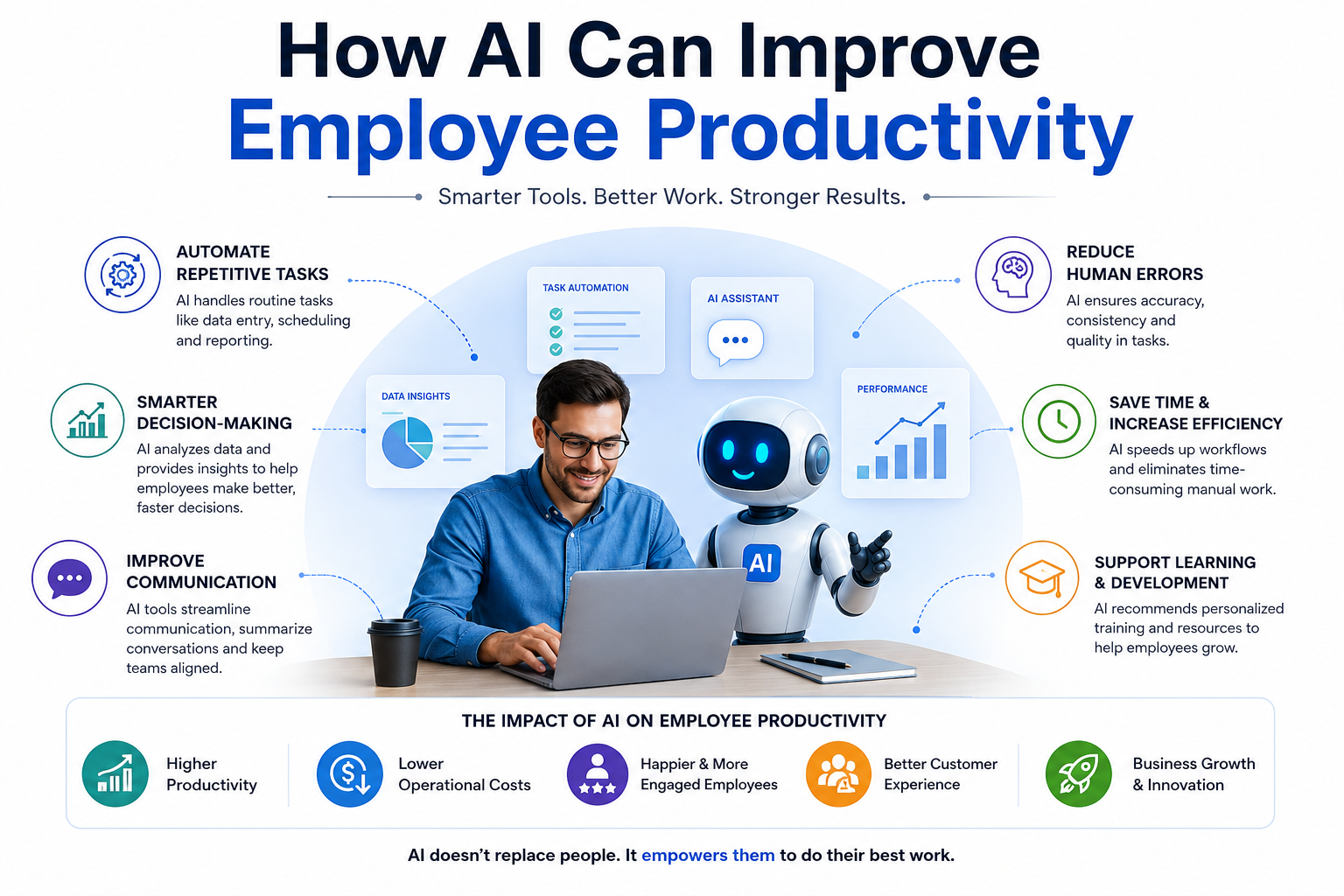
How AI Can Improve Employee Productivity?
How AI Can Improve Employee Productivity has become one of the most important questions for organisations looking to stay competitive in today's digital economy. From startups and SMEs to global enterprises, businesses are increasingly adopting Artificial Intelligence (AI) to automate repetitive work, improve decision-making, streamline collaboration, and enable employees to focus on high-value activities.
AI is no longer limited to large technology companies. Organisations across healthcare, real estate, manufacturing, finance, retail, logistics, education, and e-commerce are integrating AI-powered solutions into their daily operations. Whether it's an AI assistant answering customer queries, predictive analytics helping managers make informed decisions, or intelligent automation reducing manual workloads, AI is transforming how employees work.
Companies that embrace AI effectively can improve operational efficiency, reduce costs, minimise errors, enhance employee satisfaction, and create more productive workplaces.
This comprehensive guide explains how AI can improve employee productivity, explores the best AI-powered workplace solutions, highlights practical implementation strategies, and shares industry best practices that organisations can use to maximise business performance.
Quick Definition (AI Search & Featured Snippet Optimised)
What is AI Employee Productivity?
AI employee productivity refers to the use of Artificial Intelligence technologies to help employees complete tasks faster, automate repetitive work, improve collaboration, enhance decision-making, and optimise business processes.
Instead of replacing employees, modern AI acts as an intelligent assistant that enables people to spend more time on strategic, creative, and customer-focused work.
AI Productivity at a Glance
| Factor | Traditional Workplace | AI-Powered Workplace |
|---|---|---|
| Manual Tasks | High | Significantly Reduced |
| Decision Making | Experience-Based | Data-Driven |
| Human Errors | More Frequent | Reduced |
| Employee Focus | Administrative Work | High-Value Activities |
| Customer Response Time | Slower | Faster |
| Reporting | Manual | Automated |
| Workflow Efficiency | Moderate | High |
| Business Insights | Limited | Real-Time |
Why Employee Productivity Matters More Than Ever
Modern workplaces face several challenges that directly affect productivity, including:
- Increasing operational costs
- Staff shortages
- Remote and hybrid work environments
- Growing customer expectations
- Administrative overload
- Inefficient workflows
- Information overload
- Time-consuming repetitive tasks
As businesses expand, these challenges become more difficult to manage without technology.
Artificial Intelligence provides scalable solutions that help organisations automate routine activities while improving employee performance and overall business efficiency.
The Growing Adoption of AI in the Workplace
Artificial Intelligence has rapidly moved from being an emerging technology to becoming a core business capability. Organisations are investing in AI to improve operational efficiency, reduce costs, and empower employees with smarter tools.
Common workplace applications include:
- Intelligent virtual assistants
- AI-powered document processing
- Customer service chatbots
- Workflow automation
- Predictive analytics
- AI-powered scheduling
- Intelligent email management
- Sales forecasting
- HR automation
- Knowledge management systems
As AI capabilities continue to mature, businesses across Noida, India, the USA, Australia, the UK, Dubai, and other global markets are increasingly adopting AI-driven productivity solutions to remain competitive.
The Problem: Why Employee Productivity Declines
Many organisations unknowingly lose thousands of productive hours every year because employees spend too much time on repetitive administrative work.
Common productivity killers include:
Repetitive Administrative Tasks
Employees often spend hours on:
- Copying data between systems
- Preparing reports
- Managing spreadsheets
- Updating CRM records
- Scheduling meetings
- Processing invoices
These activities consume valuable time that could be invested in strategic work.
Poor Communication
Disconnected communication channels create:
- Duplicate work
- Missed deadlines
- Delayed approvals
- Misunderstandings
- Information silos
AI-powered collaboration platforms can centralise information and streamline communication.
Manual Data Entry
Manual processes increase the risk of:
- Human errors
- Duplicate records
- Compliance issues
- Delayed reporting
AI can automate data extraction, validation, and entry, reducing errors and improving efficiency.
Information Overload
Employees often struggle to find the right information quickly due to:
- Large document repositories
- Multiple communication platforms
- Scattered knowledge bases
AI-powered enterprise search tools and intelligent assistants can surface relevant information instantly.
Slow Decision-Making
Without real-time insights, managers rely on outdated reports or intuition. AI-powered analytics provide actionable insights that enable faster, more informed decisions.
How AI Can Improve Employee Productivity
Artificial Intelligence enhances productivity by automating repetitive tasks, supporting better decisions, improving collaboration, and enabling employees to focus on higher-value work.
1. Automating Repetitive Tasks
One of the most impactful ways AI improves workplace productivity is through automation.
AI can handle:
- Data entry
- Invoice processing
- Document classification
- Appointment scheduling
- Email sorting
- Payroll processing
- Expense management
- Compliance checks
This reduces manual effort and allows employees to concentrate on innovation, customer service, and strategic initiatives.
Example: An accounts team using AI-powered invoice processing can reduce invoice handling time from several minutes to seconds while improving accuracy.
2. Reducing Human Errors
Manual processes often lead to mistakes that require time-consuming corrections.
AI improves accuracy by:
- Validating data automatically
- Detecting anomalies
- Flagging inconsistencies
- Standardising workflows
- Enforcing business rules
This results in higher-quality outputs and reduced operational risks.
3. Improving Decision-Making
AI analyses large volumes of structured and unstructured data to identify trends, patterns, and opportunities.
Managers can use AI-generated insights to:
- Forecast sales
- Predict customer demand
- Optimise staffing
- Identify bottlenecks
- Improve resource allocation
Better decisions lead to greater efficiency and stronger business outcomes.
4. Enhancing Workplace Collaboration
AI-powered collaboration tools help teams work more effectively by:
- Summarising meetings
- Generating action items
- Translating conversations
- Organising documents
- Prioritising communications
- Tracking project progress
This reduces administrative overhead and keeps teams aligned.
5. Supporting Employee Learning and Development
AI-driven learning platforms personalise training by recommending content based on an employee's role, skills, and performance.
Benefits include:
- Faster onboarding
- Continuous upskilling
- Improved knowledge retention
- Higher employee confidence
- Increased productivity
Key Benefits of AI for Employee Productivity
| Benefit | Business Impact |
|---|---|
| Workflow Automation | Saves time and reduces manual effort |
| Improved Accuracy | Fewer errors and higher-quality outputs |
| Faster Decision-Making | Data-driven insights improve responsiveness |
| Better Collaboration | Stronger communication and teamwork |
| Operational Cost Reduction | Increased efficiency with lower overheads |
| Enhanced Customer Experience | Faster, more consistent service delivery |
| Employee Satisfaction | Less repetitive work and more meaningful tasks |
| Scalability | Supports business growth without proportional increases in workload |
AI delivers the greatest productivity gains when it augments employees rather than replaces them. Successful organisations combine intelligent automation with human expertise, using AI to eliminate repetitive work while enabling employees to focus on creativity, problem-solving, relationship building, and innovation. This balanced approach drives sustainable productivity improvements and long-term business growth.
AI Features That Significantly Improve Employee Productivity
Artificial Intelligence has evolved far beyond simple automation. Modern AI platforms combine machine learning, natural language processing (NLP), computer vision, predictive analytics, and generative AI to help employees work smarter, faster, and with greater accuracy.
Below are the key AI capabilities that deliver measurable productivity improvements.
1. Intelligent Workflow Automation
One of the biggest reasons businesses invest in AI is to automate repetitive business processes.
AI can automate:
- Invoice processing
- Data entry
- Customer onboarding
- Leave approvals
- Purchase orders
- CRM updates
- Employee attendance
- Payroll processing
- Expense approvals
- Report generation
Business Benefits
- Saves hundreds of employee hours annually
- Improves process consistency
- Eliminates repetitive work
- Reduces administrative overhead
- Increases workplace efficiency
2. AI Virtual Assistants
AI-powered assistants help employees complete daily tasks without switching between multiple applications.
They can:
- Schedule meetings
- Draft emails
- Create reports
- Retrieve company documents
- Answer HR questions
- Generate presentations
- Summarise lengthy documents
- Translate conversations
- Provide project updates
Example
Instead of spending 30 minutes preparing meeting notes, employees can use AI to generate an organised summary in seconds.
3. Predictive Analytics
AI analyses historical and real-time data to forecast future outcomes.
Examples include:
- Sales forecasting
- Inventory prediction
- Workforce planning
- Customer demand forecasting
- Financial planning
- Maintenance scheduling
Managers can make proactive decisions rather than reacting after problems occur.
4. Intelligent Document Processing
Businesses handle thousands of documents every month.
AI automatically extracts information from:
- PDFs
- Contracts
- Invoices
- Insurance forms
- Medical records
- Purchase orders
- Identity documents
This eliminates manual document review and significantly accelerates business operations.
5. AI Knowledge Management
Employees often waste valuable time searching for information.
AI-powered knowledge systems enable users to:
- Ask questions in natural language
- Instantly locate policies and procedures
- Retrieve technical documentation
- Find project files
- Access previous conversations
- Search company databases
This reduces information retrieval time and improves decision-making.
6. AI-Powered Collaboration
Modern collaboration tools use AI to improve communication across teams.
Features include:
- Automatic meeting transcription
- Action-item generation
- Smart scheduling
- Language translation
- Project tracking
- Team productivity insights
These capabilities support remote, hybrid, and distributed teams.
7. Intelligent Task Prioritisation
AI analyses workloads and deadlines to recommend task priorities.
Benefits include:
- Reduced employee stress
- Better workload balancing
- Improved project delivery
- Increased productivity
- Enhanced time management
Step-by-Step Process to Implement AI for Employee Productivity
Successful AI adoption requires a structured approach rather than deploying technology without a clear strategy.
Step 1: Identify Productivity Challenges
Start by analysing current workflows.
Ask questions such as:
- Which tasks consume the most time?
- Where do employees experience delays?
- Which processes are repetitive?
- Where do most errors occur?
- Which departments require automation?
Common focus areas include:
- HR
- Finance
- Customer Support
- Sales
- Marketing
- Operations
- IT
Step 2: Set Clear Business Objectives
Define measurable goals, such as:
- Reduce administrative work by 40%
- Improve response time by 60%
- Decrease manual errors by 50%
- Increase customer satisfaction
- Improve employee engagement
- Lower operational costs
Clear KPIs help measure AI success.
Step 3: Select the Right AI Solutions
Choose solutions based on business needs.
Examples include:
| Business Need | AI Solution |
|---|---|
| Customer Support | AI Chatbots |
| HR | AI Recruitment Software |
| Sales | AI CRM Assistant |
| Marketing | AI Content Generation |
| Finance | AI Invoice Processing |
| IT | AI Helpdesk Automation |
| Operations | Workflow Automation |
| Analytics | AI Business Intelligence |
Step 4: Prepare High-Quality Data
AI systems depend on accurate, structured, and relevant data.
Best practices include:
- Remove duplicate records
- Standardise formats
- Clean outdated information
- Protect sensitive data
- Establish governance policies
Poor data quality leads to unreliable AI outcomes.
Step 5: Train Employees
Technology adoption succeeds when employees understand how to use it.
Training should cover:
- AI capabilities
- Ethical AI usage
- Data privacy
- Workflow integration
- Prompt writing (for generative AI)
- Human review processes
Step 6: Start with Pilot Projects
Instead of organisation-wide deployment:
- Select one department
- Automate one workflow
- Measure results
- Collect employee feedback
- Refine processes
- Scale gradually
This reduces implementation risks and builds confidence.
Step 7: Continuously Optimise
AI is not a one-time project.
Regularly review:
- Productivity metrics
- Employee adoption
- Automation performance
- Cost savings
- Customer satisfaction
- Business outcomes
Continuous improvement ensures long-term value.
Best AI Tools for Improving Employee Productivity
| AI Tool Category | Business Use Case |
|---|---|
| Generative AI Assistants | Content creation, document drafting, brainstorming |
| AI Chatbots | Customer support and internal help desks |
| CRM AI | Sales forecasting and lead management |
| AI Project Management | Task tracking and resource allocation |
| AI Meeting Assistants | Meeting summaries and action items |
| AI Document Automation | Invoice and contract processing |
| AI Analytics Platforms | Business intelligence and forecasting |
| AI HR Solutions | Recruitment, onboarding, and employee engagement |
Selection Tip: Choose platforms that integrate with your existing ERP, CRM, HRMS, and collaboration tools to maximise adoption and minimise disruption.
Industry-Specific Applications of AI
Startups
AI enables startups to scale with lean teams.
Common applications:
- Customer support automation
- AI marketing assistants
- Sales lead scoring
- Business analytics
- Financial forecasting
SMEs
Small and medium-sized businesses use AI to:
- Automate accounting
- Improve customer service
- Optimise inventory
- Increase marketing ROI
- Reduce operational costs
Enterprises
Large organisations deploy AI for:
- Enterprise automation
- Intelligent document processing
- Predictive analytics
- Supply chain optimisation
- Workforce planning
- Cybersecurity monitoring
Healthcare
Healthcare providers use AI to:
- Schedule appointments
- Assist with medical documentation
- Optimise resource allocation
- Support clinical decision-making
- Automate billing processes
Real Estate
AI improves productivity by:
- Qualifying leads
- Matching buyers with properties
- Predicting market trends
- Automating follow-ups
- Generating property descriptions
E-commerce
Retail and e-commerce businesses leverage AI for:
- Personalised recommendations
- Demand forecasting
- Inventory management
- Customer support automation
- Fraud detection
Real-World Case Study Examples
Case Study 1: Customer Support Automation
Challenge: A growing services company struggled with a high volume of repetitive customer enquiries.
Solution: An AI chatbot handled common requests, escalating only complex issues to support staff.
Results:
- Faster response times
- Reduced support workload
- Higher customer satisfaction
- Improved employee focus on complex cases
Case Study 2: HR Recruitment Automation
Challenge: HR teams spent excessive time reviewing applications and scheduling interviews.
Solution: AI-assisted recruitment streamlined CV screening, candidate ranking, and interview scheduling.
Results:
- Faster hiring cycles
- Reduced administrative effort
- Improved candidate experience
- More time for strategic HR activities
Case Study 3: Finance Process Automation
Challenge: Manual invoice processing delayed supplier payments and increased errors.
Solution: Intelligent document processing extracted invoice data and routed approvals automatically.
Results:
- Shorter processing times
- Fewer manual errors
- Improved compliance
- Better supplier relationships
AI Productivity Statistics and Industry Insights
The growing adoption of AI reflects its measurable business value. Industry research consistently highlights several key trends:
| Statistic | Business Insight |
|---|---|
| Most organisations are increasing AI investment | AI is becoming a core business capability rather than an experimental technology. |
| Generative AI adoption is accelerating across knowledge-based roles | Employees are using AI to draft content, summarise information, and support decision-making. |
| Automation delivers the highest ROI for repetitive, rules-based tasks | Administrative workflows often provide the quickest productivity gains. |
| Hybrid work has increased demand for AI collaboration tools | Intelligent meeting summaries, search, and knowledge management improve distributed teamwork. |
| Businesses prioritising responsible AI governance achieve stronger long-term adoption | Clear policies, training, and human oversight improve trust and sustainable outcomes. |
Common Mistakes Businesses Make When Implementing AI
While AI offers significant productivity benefits, many organisations fail to achieve expected results due to poor planning and execution.
1. Implementing AI Without Clear Objectives
Many businesses adopt AI because competitors are doing so rather than solving a specific business challenge.
Solution: Define measurable goals such as:
- Reduce manual processing time by 50%
- Improve customer response times by 40%
- Increase employee productivity by 30%
2. Poor Data Quality
AI systems rely on accurate data.
Common issues include:
- Duplicate records
- Incomplete information
- Outdated databases
- Inconsistent formats
Solution: Establish strong data governance before deployment.
3. Ignoring Employee Training
Even the best AI solutions fail if employees don't understand how to use them.
Solution:
- Provide AI training programmes
- Offer ongoing support
- Create internal AI usage guidelines
4. Expecting AI to Replace Humans
AI is most effective when it augments human capabilities rather than replacing employees.
Solution: Focus on human-AI collaboration.
5. Neglecting Security and Compliance
AI systems often process sensitive business information.
Solution:
- Implement cybersecurity controls
- Follow GDPR and regional compliance standards
- Establish responsible AI policies
Best Practices for Using AI to Improve Employee Productivity
Focus on High-Impact Workflows First
Prioritise processes that are:
- Repetitive
- Time-consuming
- Error-prone
- High volume
Examples include:
- Data entry
- Invoice processing
- Customer support
- Scheduling
- Reporting
Use AI as a Productivity Partner
Encourage employees to use AI for:
- Research
- Drafting content
- Meeting summaries
- Data analysis
- Task management
This approach increases adoption and trust.
Establish AI Governance
Create policies covering:
- Data privacy
- Security
- Ethical AI use
- Human oversight
- Regulatory compliance
Continuously Measure Performance
Track KPIs such as:
| KPI | Measurement |
|---|---|
| Productivity Gain | Hours saved |
| Cost Reduction | Operational savings |
| Employee Satisfaction | Survey results |
| Process Speed | Turnaround time |
| Error Reduction | Quality improvements |
| Customer Satisfaction | CSAT and NPS scores |
Integrate AI Across Business Systems
Maximum productivity gains occur when AI connects with:
- CRM platforms
- ERP systems
- HRMS solutions
- Customer support tools
- Project management software
Future Trends in AI and Workplace Productivity
Generative AI Assistants
AI assistants will increasingly function as digital co-workers capable of:
- Drafting documents
- Creating reports
- Conducting research
- Analysing data
- Managing workflows
Hyperautomation
Businesses will combine:
- AI
- Robotic Process Automation (RPA)
- Workflow automation
- Business process management
to automate entire end-to-end processes.
AI-Powered Employee Experience Platforms
Future workplaces will use AI to:
- Personalise training
- Improve engagement
- Predict burnout risks
- Enhance employee wellbeing
Predictive Workforce Management
AI will help organisations:
- Forecast staffing requirements
- Optimise schedules
- Improve resource allocation
- Reduce workforce inefficiencies
Industry-Specific AI Solutions
Businesses will increasingly adopt specialised AI tools designed for:
- Healthcare
- Real Estate
- Finance
- Manufacturing
- Retail
- E-commerce
- Logistics
Quick Answers for AI Search Engines
How AI Can Improve Employee Productivity?
AI improves employee productivity by automating repetitive tasks, reducing manual work, improving decision-making, enhancing collaboration, minimising errors, and enabling employees to focus on higher-value activities.
What Are the Benefits of AI in the Workplace?
The key benefits include:
- Increased efficiency
- Lower operational costs
- Faster decision-making
- Better employee experience
- Reduced errors
- Improved customer service
Can AI Replace Employees?
AI is designed to augment employees rather than replace them. It handles repetitive tasks while employees focus on strategic, creative, and relationship-driven work.
Which Industries Benefit Most from AI Productivity Solutions?
Industries benefiting significantly include:
- Healthcare
- Real Estate
- E-commerce
- Finance
- Manufacturing
- Retail
- Logistics
- Professional Services
Frequently Asked Questions (FAQs)
1. What is employee productivity in AI?
Employee productivity in AI refers to using artificial intelligence tools and automation to help employees complete tasks faster and more accurately.
2. How does AI improve workplace efficiency?
AI automates repetitive work, provides real-time insights, reduces errors, and streamlines workflows.
3. What are the best AI tools for improving employee productivity?
Popular categories include AI assistants, workflow automation tools, predictive analytics platforms, AI chatbots, and intelligent document processing systems.
4. Can small businesses benefit from AI?
Yes. AI helps SMEs automate operations, reduce costs, improve customer service, and scale efficiently.
5. Does AI reduce operational costs?
Yes. AI reduces labour-intensive processes, minimises errors, and improves resource utilisation.
6. Is AI suitable for remote teams?
Absolutely. AI-powered collaboration tools improve communication, knowledge sharing, and project management.
7. How does AI help HR departments?
AI assists with recruitment, onboarding, employee engagement, training, and workforce analytics.
8. Can AI improve customer support productivity?
Yes. AI chatbots and virtual assistants handle routine enquiries, allowing support teams to focus on complex issues.
9. What are the risks of implementing AI?
Potential risks include poor data quality, lack of employee training, privacy concerns, and weak governance.
10. How can businesses start using AI?
Begin with a productivity audit, identify repetitive processes, implement pilot projects, and scale based on results.
11. How does AI reduce human errors?
AI automates rule-based tasks and validates data, reducing manual mistakes.
12. What role does Generative AI play in productivity?
Generative AI assists with content creation, coding, summarisation, research, and business communications.
13. Can AI improve employee satisfaction?
Yes. By reducing repetitive work, AI enables employees to focus on meaningful and engaging tasks.
14. How quickly can businesses see results from AI?
Many organisations experience measurable productivity improvements within a few months of implementation.
15. What is the future of AI in workplace productivity?
The future includes AI co-workers, hyperautomation, predictive workforce management, and highly personalised employee experiences.
Conclusion
Artificial Intelligence is rapidly becoming one of the most powerful drivers of workplace productivity. Businesses across Noida, India, the USA, Australia, the UK, Dubai, and global markets are leveraging AI to automate repetitive tasks, improve decision-making, streamline workflows, and empower employees to focus on strategic initiatives.
The organisations achieving the greatest success are those that view AI as a business transformation tool rather than just another technology investment. By combining AI automation, intelligent analytics, and human expertise, companies can unlock significant gains in productivity, efficiency, employee satisfaction, and profitability.
Whether you're a startup looking to scale efficiently, an SME seeking operational excellence, or an enterprise pursuing digital transformation, AI offers a practical path to achieving sustainable business growth.
Transform Employee Productivity with TGAYS Technology
At TGAYS Technology, we help businesses leverage Artificial Intelligence, Automation, Custom Software Development, AI Agents, AI Chatbots, CRM Solutions, ERP Systems, and Enterprise Applications to improve workforce productivity and accelerate digital transformation.
Our AI experts can help you:
- Identify automation opportunities
- Develop custom AI solutions
- Implement AI-powered business processes
- Build intelligent chatbots and AI agents
- Integrate AI into existing systems
- Improve operational efficiency
Ready to improve employee productivity with AI?
Visit TGAYS Technology today and discover how AI can transform your business.
Article Summary
This guide explained how AI can improve employee productivity by automating repetitive tasks, enhancing collaboration, reducing errors, and supporting data-driven decision-making. It covered implementation strategies, best practices, industry-specific applications, future trends, common mistakes, and actionable recommendations for organisations looking to improve workplace efficiency through Artificial Intelligence.