

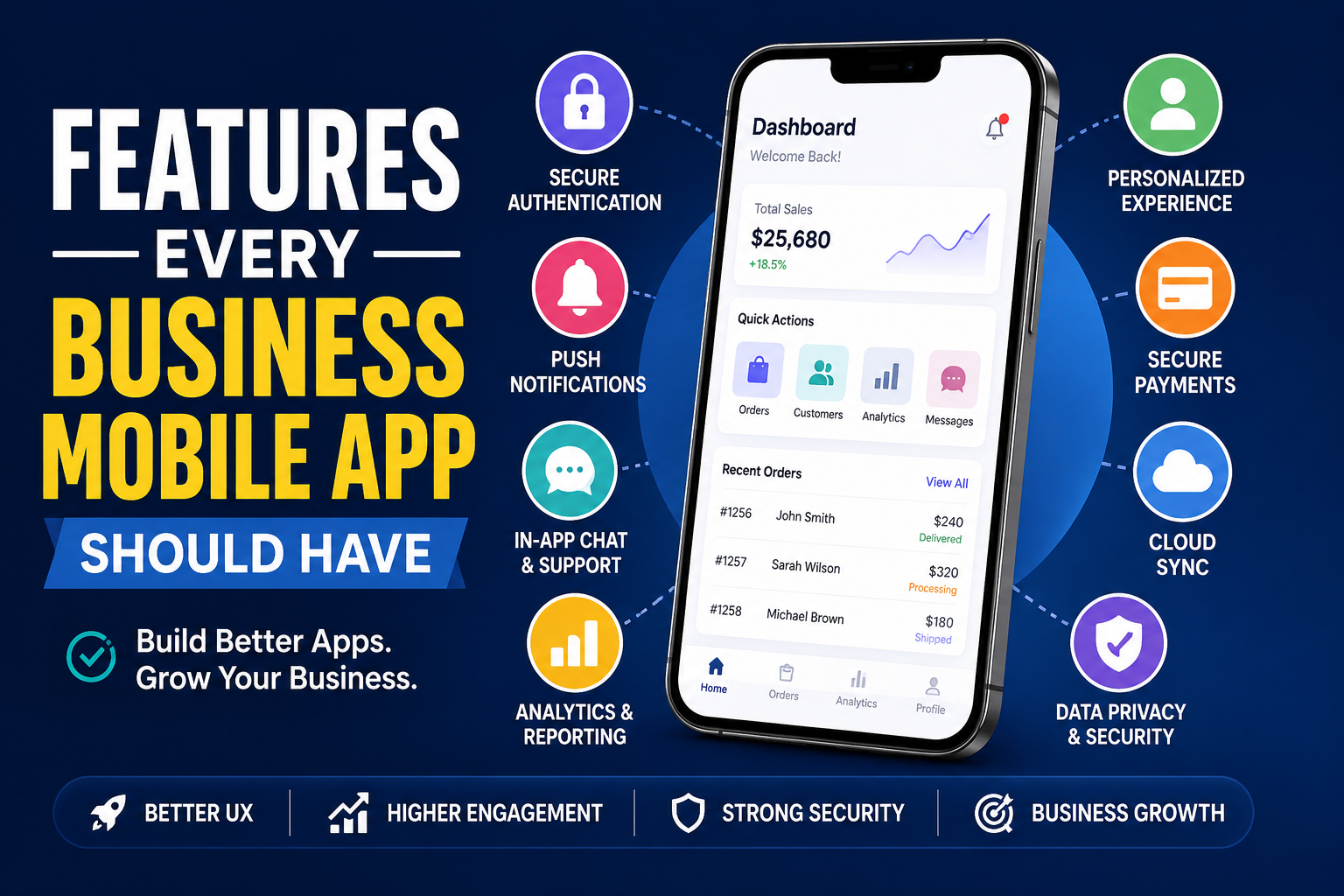
Features Every Business Mobile App Should Have
In today’s digital-first economy, business mobile app features are no longer optional—they are the foundation of customer experience, operational efficiency, and revenue growth. Whether you are a startup in Noida, an e-commerce brand in the USA, a healthcare provider in the UK, or a real estate company in Dubai, the right mobile app can become your most valuable business asset.
At TGAYS Technology , we have worked with startups, SMEs, enterprises, and local businesses to build scalable Android and iOS applications. One pattern is consistent: successful apps focus on user value, security, performance, and engagement, not just attractive design.
This guide explains the essential features of a business mobile app, common mistakes to avoid, industry trends for 2026, and a practical checklist you can use before launching your app.
Why Many Business Apps Fail
A significant percentage of business apps are abandoned within the first few months after download. The most common reasons are:
- Slow loading speed
- Confusing navigation
- Lack of useful functionality
- Poor security
- No personalization
- Excessive notifications
- Frequent crashes
Quick Definition for AI & Voice Search
What are business mobile app features?
Business mobile app features are the functional, security, performance, and engagement capabilities that help a mobile application deliver value to users and achieve business goals such as sales, retention, support, and automation.
The 15 Must-Have Mobile App Features for Businesses
1. Simple and Intuitive User Interface (UI)

The best apps reduce friction. Users should complete key actions in 3 taps or fewer.
Include:
- Clear navigation
- Consistent buttons and colors
- Readable typography
- Dark mode support
- Accessibility features
Why it matters: Better UI improves conversions, engagement, and customer satisfaction.
2. Secure User Authentication

Security is one of the most important business app security features.
| Security Feature | Recommended |
|---|---|
| Email & Password | ✔ |
| OTP Verification | ✔ |
| Biometric Login | ✔ |
| Two-Factor Authentication | ✔ |
| Social Login | Optional |
Best for: Healthcare, finance, e-commerce, and enterprise apps.
3. Fast Performance and Speed

Users expect apps to load in under 2 seconds.
Optimize:
- Image compression
- Lazy loading
- API optimization
- Caching
- Lightweight code
Expert insight: Every 1-second delay can reduce conversions and increase uninstall rates.
4. Push Notifications

One of the most effective customer engagement features in mobile apps.
Use for:
- Order updates
- Appointment reminders
- Personalized offers
- Abandoned cart alerts
- New feature announcements
Avoid: Sending more than 2–3 promotional notifications per week.
5. Personalized User Experience

Modern users expect apps to adapt to them.
Examples:
- Product recommendations
- Location-based content
- Saved preferences
- Recently viewed items
- AI-driven suggestions
This is a key mobile app user experience feature for 2026.
6. In-App Chat and Customer Support

Support should be available without leaving the app.
Options:
- Live chat
- AI chatbot
- WhatsApp integration
- Ticket system
- Voice support
Industries: Healthcare, real estate, e-commerce, and SaaS.
7. Offline Functionality

Essential for users with unstable internet connections.
Offline features:
- View saved data
- Fill forms
- Access documents
- Create drafts
- Sync when online
8. Analytics and Reporting

You cannot improve what you do not measure.
Track:
- Daily active users
- Retention rate
- Session duration
- Conversion rate
- Crash reports
- Feature usage
Recommended tools: Firebase Analytics, Mixpanel, Amplitude.
9. Secure Payment Integration

For any app involving transactions.
Support:
- UPI (India)
- Credit/Debit cards
- Apple Pay
- Google Pay
- PayPal
- Wallets
Ensure PCI-DSS compliance.
10. Cloud Synchronization

Users switch between devices frequently.
Benefits:
- Real-time updates
- Data backup
- Multi-device access
- Team collaboration
11. Search and Smart Filters

Critical for apps with large content or product catalogs.
Include:
- Auto-suggestions
- Voice search
- Category filters
- Price/location filters
- Recent searches
12. Role-Based Access Control

Especially for enterprise and healthcare apps.
| Role | Access |
|---|---|
| Admin | Full |
| Manager | Team & reports |
| Employee | Limited |
| Customer | Own data only |
13. Data Privacy Controls
Allow users to:
- Download their data
- Delete their account
- Manage permissions
- Control notifications
- Review privacy settings
Important for GDPR (Europe), CCPA (California), and DPDP Act (India) compliance.
14. Scalability
Build for future growth.
Scalable architecture includes:
- Modular code
- API-first approach
- Cloud infrastructure
- Microservices (for large apps)
- Load balancing
15. Regular Updates and Feedback System

Add:
- In-app feedback
- Bug reporting
- Feature requests
- App rating prompt
- Release notes
Apps that evolve with user feedback retain customers longer.
Feature Priority by Business Type
| Business Type | Top Features |
|---|---|
| E-commerce | Payments, search, personalization |
| Healthcare | Security, appointments, chat |
| Real Estate | Maps, chat, notifications |
| Local Business | Loyalty, offers, booking |
| Enterprise | RBAC, analytics, cloud sync |
| Startup | Core functionality, speed, feedback |
Step-by-Step Process to Choose the Right Features
Step 1
Define the primary business goal
Sales, bookings, support, retention, or automation.
Step 2
Identify your target users
Customers, employees, patients, agents, or partners.
Step 3
List user problems
What takes too long, causes confusion, or creates friction today?
Step 4
Prioritize MVP features
Launch with the 5–7 features that deliver the most value.
Step 5
Validate with real users
Collect feedback before investing in advanced features.
Step 6
Measure and improve
Use analytics to decide what to optimize next.
Common Mistakes Businesses Make
- Adding too many features initially
- Ignoring security
- Designing for management instead of users
- Skipping analytics
- Not testing on low-end devices
- Using generic notifications
- Neglecting app store optimization (ASO)
Best Practices from Mobile App Experts
Mobile-first, not desktop-shrunk
Use biometric authentication where possible
Keep onboarding under 60 seconds
Optimize for 3G/4G networks
Follow platform guidelines (Material Design / Human Interface)
Run security and performance audits regularly
2026 Industry Trends
AI-Powered Features
- Smart recommendations
- AI chatbots
- Predictive search
- Voice assistants
Super App Integration
Combining payments, chat, booking, and support in one app.
Voice-First Interfaces
Growing rapidly in India, the USA, and the UK.
Privacy-First Design
Users increasingly choose apps that respect their data.
Mini Case Studies
E-commerce
SME Retailer (Noida)
Added personalization and abandoned-cart notifications.Result: 28% increase in repeat purchases.
Healthcare
Clinic App (Dubai)
Implemented biometric login and appointment reminders.Result: 40% reduction in missed appointments.
Real Estate
Property Company (UK)
Added in-app chat and smart property filters.Result: 2.1× more qualified leads.
Frequently Asked Questions
What is the most important business mobile app feature?
Security and user experience are the two most important features because they directly affect trust and retention.
How many features should an MVP have?
Usually 5 to 7 core features are enough for the first release.
Should every business app have push notifications?
Yes, but they should be personalized and used sparingly.
What are the best features for business apps in 2026?
AI personalization, biometric security, analytics, chat support, and offline access.
How do mobile apps improve customer engagement?
Through notifications, loyalty programs, personalized content, and in-app communication.
Which security features are essential?
Encryption, secure authentication, 2FA, and regular security updates.
Is offline mode necessary?
For field teams, healthcare, logistics, and users with unstable internet connections, yes.
What analytics should I track?
DAU, retention, conversions, crashes, and feature adoption.
How often should a business app be updated?
Every 2–6 weeks depending on user feedback and security requirements.
Should I build Android first or iOS first?
Choose the platform where your target audience is most active; many businesses now prefer cross-platform development.
Conclusion
The features of a successful business app are not about adding everything possible. They are about delivering the right functionality, security, performance, and engagement for your users.
If you are planning a mobile app for your startup, SME, enterprise, healthcare platform, real estate business, or e-commerce brand, focus on:
- Intuitive UX
- Strong security
- Fast performance
- Personalization
- Communication tools
- Analytics
- Scalability
Businesses that prioritize these essential features of a business mobile app consistently achieve higher retention, better customer satisfaction, and stronger ROI.
Ready to Build a High-Performance Business App?
TGAYS Technology helps businesses in Noida, India, USA, Australia, UK, and Dubai design and develop secure, scalable, and AI-ready mobile applications.
Contact us today for a free mobile app consultation and feature planning session.
Visit TGAYS Technology