

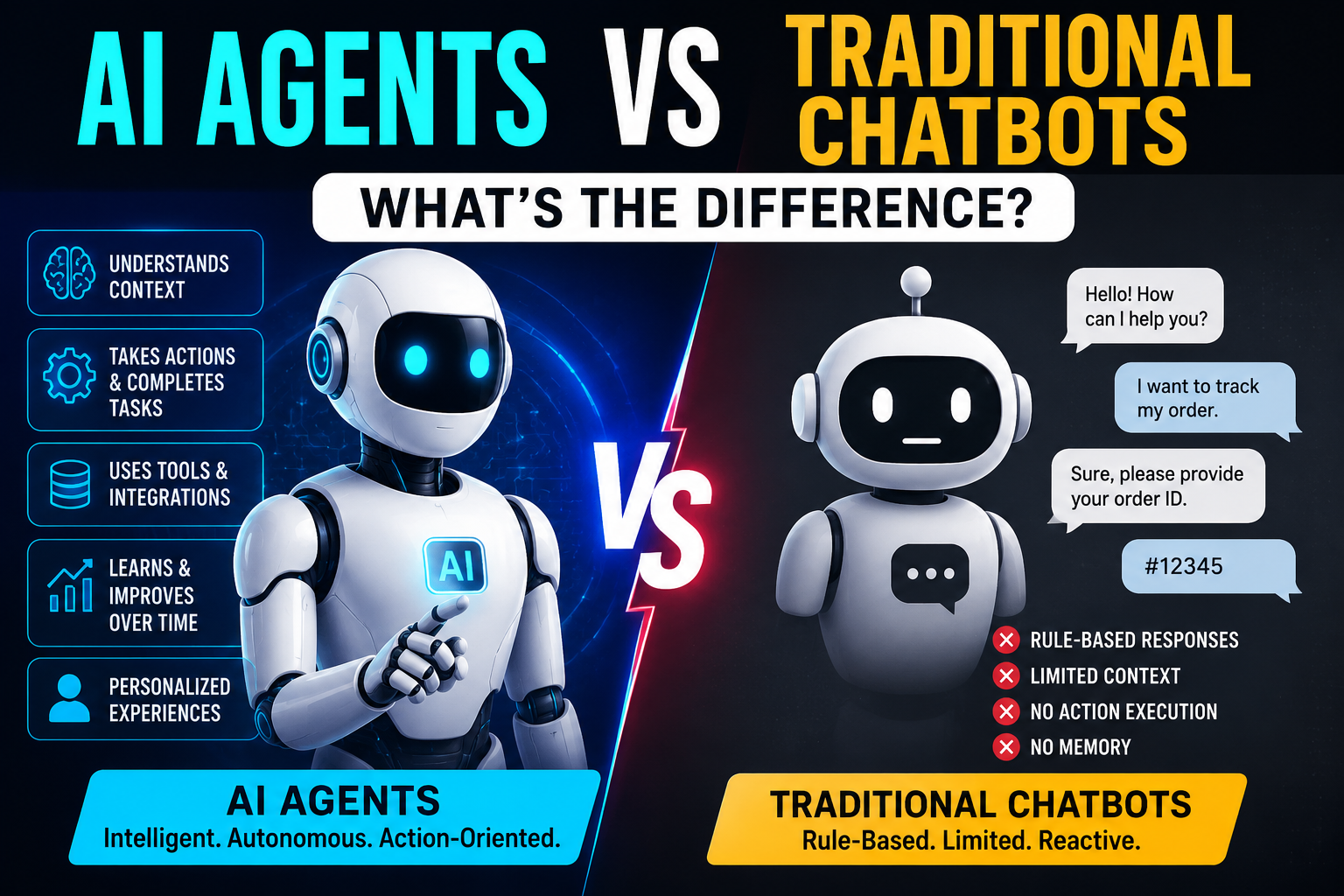
AI Agents vs Traditional Chatbots: What's the Difference?
Artificial intelligence is transforming the way businesses interact with customers, automate operations, and improve decision-making. While chatbots have been a popular customer engagement tool for years, the rise of AI agents has introduced a new generation of intelligent systems capable of reasoning, planning, learning, and independently completing complex tasks.
Understanding AI Agents vs Traditional Chatbots has become increasingly important for startups, SMEs, enterprises, healthcare providers, real estate companies, eCommerce businesses, and local organisations looking to invest in AI-powered automation. Although both technologies enable conversational interactions, they differ significantly in intelligence, autonomy, adaptability, and business value.
Traditional chatbots primarily follow predefined rules or scripted conversational flows. AI agents, on the other hand, leverage Large Language Models (LLMs), memory, reasoning capabilities, tool integrations, and autonomous decision-making to perform sophisticated tasks with minimal human intervention.
As businesses worldwide—including those in Noida, India, the USA, Australia, the UK, and Dubai—embrace AI-driven digital transformation, selecting the right solution can directly impact customer satisfaction, operational efficiency, and return on investment.
This comprehensive guide explains AI agents vs traditional chatbots, compares their capabilities, explores real-world business applications, and helps you determine which technology aligns with your organisation's goals.
The Growing Challenge Businesses Face
Many organisations invest in chatbot technology expecting fully automated customer support and streamlined business operations. However, they often encounter several limitations:
- Chatbots struggle with unexpected questions.
- Conversations break when users deviate from predefined scripts.
- Complex workflows still require human intervention.
- Limited personalisation reduces customer satisfaction.
- Chatbots cannot independently perform business actions.
These challenges have accelerated the adoption of AI agents capable of understanding context, reasoning through problems, integrating with business systems, and completing multi-step workflows.
Businesses are no longer looking for systems that simply answer questions—they need AI solutions that actively contribute to business outcomes.
What is the difference between AI agents and traditional chatbots?
Traditional chatbots are rule-based or intent-based conversational systems designed to answer predefined questions using scripted workflows.
AI agents are autonomous AI-powered systems capable of understanding context, reasoning, remembering previous interactions, using external tools, accessing business data, making decisions, and completing complex tasks with minimal human assistance.
Simply put:
Traditional chatbots answer questions. AI agents solve problems and accomplish goals.
AI Agents vs Traditional Chatbots Explained
Traditional chatbots operate using predefined conversation flows, keyword matching, or rule-based logic. They perform well for answering FAQs and handling repetitive customer interactions but struggle with complex requests.
AI agents use advanced Large Language Models (LLMs), memory, reasoning, planning, and external tool integrations to perform autonomous business tasks. They can understand context, adapt conversations, retrieve information from multiple systems, execute workflows, and continuously improve through learning.
What Is a Traditional Chatbot?
A traditional chatbot is a software application designed to simulate conversations using predefined rules, decision trees, or intent classification.
Most traditional chatbots rely on:
- Decision trees
- Keyword recognition
- Menu-based navigation
- Predefined responses
- FAQ databases
- Static workflows
They are commonly used for:
- Customer support
- Appointment booking
- Order tracking
- Frequently Asked Questions
- Basic lead generation
- Contact information collection
How Traditional Chatbots Work
A typical chatbot follows this process:
- User submits a question.
- Chatbot identifies keywords or intent.
- Searches predefined responses.
- Returns the closest available answer.
- Waits for the next query.
If the user asks something outside its programmed knowledge, the chatbot often fails or escalates the conversation to a human agent.
What Is an AI Agent?
An AI agent is an intelligent software system capable of perceiving information, reasoning about objectives, making decisions, interacting with external systems, and autonomously completing tasks.
Unlike traditional chatbots, AI agents can:
- Understand natural language deeply
- Maintain conversational memory
- Plan multiple steps to achieve goals
- Access databases and APIs
- Execute business workflows
- Learn from interactions
- Collaborate with other AI systems
- Make contextual decisions
AI agents are powered by technologies such as:
- Large Language Models (LLMs)
- Retrieval-Augmented Generation (RAG)
- Machine Learning
- Knowledge Graphs
- API Integrations
- Workflow Automation Engines
- Vector Databases
- Multi-Agent Architectures
Instead of merely answering questions, AI agents can perform actions such as:
- Scheduling appointments
- Updating CRM records
- Processing customer requests
- Generating reports
- Sending emails
- Analysing business data
- Automating internal operations
AI Agents vs Traditional Chatbots: Comparison Table
| Feature | Traditional Chatbots | AI Agents |
|---|---|---|
| Intelligence | Rule-based | AI-powered reasoning |
| Learning Ability | Limited | Continuous improvement |
| Memory | Usually none | Long-term contextual memory |
| Decision Making | No | Yes |
| Context Awareness | Limited | Advanced |
| Multi-Step Tasks | Not supported | Fully supported |
| API Integration | Basic | Extensive |
| Workflow Automation | Minimal | Advanced |
| Personalisation | Low | High |
| Natural Conversations | Limited | Human-like |
| Adaptability | Static | Dynamic |
| Tool Usage | Rare | Native capability |
| Business Automation | Limited | End-to-end automation |
| Scalability | Moderate | Enterprise-grade |
| Human Dependency | High | Much lower |
AI Chatbot vs AI Agent Comparison
Although modern AI chatbots may use generative AI, they are often designed primarily for conversation. An AI agent goes several steps further by combining conversational intelligence with planning, reasoning, memory, and task execution.
Traditional AI Chatbot
- Responds to questions
- Provides recommendations
- Answers FAQs
- Assists users during conversations
- Limited autonomy
Intelligent AI Agent
- Understands business goals
- Plans tasks independently
- Executes workflows
- Connects with multiple business systems
- Monitors outcomes
- Optimises future actions
This distinction is why many organisations are transitioning from simple conversational bots to autonomous AI agents.
How AI Agents Differ from Traditional Chatbots
1. Intelligence
Traditional chatbots rely on predefined scripts and programmed logic.
AI agents analyse intent, understand context, reason through complex scenarios, and generate intelligent responses.
2. Context Retention
Most traditional chatbots forget previous conversations once the session ends.
AI agents maintain contextual memory across interactions, enabling more personalised and consistent user experiences.
3. Decision-Making Capabilities
Traditional chatbots cannot make independent decisions.
AI agents evaluate available information, compare options, and recommend or execute the best course of action based on predefined goals and policies.
4. Workflow Automation
A chatbot typically ends after providing information.
An AI agent can:
- Retrieve customer records
- Verify account details
- Update CRM systems
- Generate invoices
- Book appointments
- Send notifications
- Trigger business workflows
- Produce reports automatically
5. Learning and Adaptability
Rule-based chatbots require manual updates whenever new scenarios arise.
AI agents continuously improve by leveraging:
- Updated knowledge sources
- Feedback loops
- Retrieval systems
- Enhanced prompts
- Business data integrations
6. Tool Integration
Traditional chatbots usually operate in isolation.
AI agents integrate seamlessly with:
- CRM platforms
- ERP systems
- Email services
- Payment gateways
- Business Intelligence tools
- Inventory systems
- Marketing automation software
- Project management platforms
Conversational AI vs AI Agents
Many people mistakenly use these terms interchangeably.
Conversational AI
Conversational AI focuses on enabling natural language interactions between humans and machines. It excels at answering questions, assisting users, and facilitating conversations through text or voice.
AI Agents
AI agents build upon conversational AI by adding reasoning, planning, memory, decision-making, and the ability to take actions across connected systems. They move beyond conversation to autonomously accomplish business objectives.
In essence: Conversational AI talks with users; AI agents work on behalf of users.
When Should You Use a Traditional Chatbot?
A traditional chatbot remains a practical choice when your organisation needs:
- Frequently Asked Questions (FAQs)
- Basic customer support
- Appointment scheduling
- Contact form automation
- Lead qualification
- Simple order tracking
- Limited-budget automation
- Straightforward conversational flows
For these scenarios, a chatbot can deliver quick responses and reduce the workload on support teams without the complexity of a full AI agent.
When Should You Choose an AI Agent?
An AI agent is the better solution when your business requires:
- Complex customer service interactions
- Multi-step workflow automation
- Personalised recommendations
- CRM and ERP integration
- Autonomous task execution
- Data analysis and reporting
- Intelligent decision support
- Cross-department automation
- AI-powered business operations
- Enterprise-scale automation
Businesses aiming to improve productivity, reduce manual effort, and deliver highly personalised customer experiences will benefit most from adopting AI agents.
Benefits of AI Agents Over Traditional Chatbots
As businesses increasingly embrace intelligent automation, the debate around AI Agents vs Traditional Chatbots has shifted from "Which technology is newer?" to "Which technology delivers measurable business value?"
Traditional chatbots remain useful for handling repetitive customer interactions. However, AI agents offer a broader range of capabilities that drive efficiency, improve customer experiences, and enable organisations to automate complex business processes.
Below are the key advantages AI agents provide over traditional chatbot solutions.
1. Intelligent Decision-Making
Unlike traditional chatbots that follow predefined conversation trees, AI agents analyse context, evaluate multiple options, and determine the most appropriate response or action.
For example, an AI agent can:
- Recommend products based on purchase history
- Prioritise customer support tickets
- Detect fraudulent transactions
- Escalate urgent cases automatically
- Optimise inventory recommendations
This capability significantly reduces manual intervention.
2. Context-Aware Conversations
Traditional chatbots often treat every conversation as a new interaction.
AI agents maintain conversational memory by remembering:
- Previous discussions
- Customer preferences
- Purchase history
- Business context
- Current workflow stage
This creates personalised and natural interactions that increase customer satisfaction.
3. End-to-End Task Automation
Perhaps the biggest difference in AI Agents vs Traditional Chatbots is the ability to complete entire workflows.
Instead of simply answering:
"Your appointment has been scheduled."
An AI agent can actually:
- Check calendar availability
- Book appointments
- Send confirmation emails
- Create CRM entries
- Notify internal teams
- Schedule reminders
- Update dashboards
All without human involvement.
4. Improved Customer Experience
Modern customers expect immediate, accurate, and personalised responses.
AI agents improve customer experience by offering:
- Faster resolutions
- 24/7 availability
- Personalised recommendations
- Multi-language support
- Reduced waiting times
- Human-like conversations
5. Higher Operational Efficiency
AI agents automate repetitive administrative tasks such as:
- Invoice generation
- CRM updates
- Lead qualification
- Report creation
- Ticket routing
- Data entry
Employees can focus on strategic and revenue-generating work instead.
6. Better Business Intelligence
AI agents do more than communicate.
They continuously analyse:
- Customer behaviour
- Sales trends
- Operational bottlenecks
- Marketing performance
- Employee productivity
This enables better business decisions.
7. Continuous Learning
Rule-based chatbots require manual updates whenever business requirements change.
AI agents continuously improve through:
- Updated knowledge bases
- Retrieval-Augmented Generation (RAG)
- Feedback loops
- Fine-tuning
- Prompt optimisation
Key Features of AI Agents:
The following capabilities distinguish AI agents from traditional chatbots.
Autonomous Reasoning
AI agents analyse situations before responding instead of relying solely on scripted answers.
Long-Term Memory
They remember:
- Previous conversations
- User preferences
- Business objectives
- Historical interactions
Tool Usage
AI agents can interact with:
- CRM software
- ERP platforms
- Email systems
- Payment gateways
- Databases
- APIs
- Calendar applications
- Cloud storage
Multi-Step Planning
Instead of handling one request at a time, AI agents can:
- Understand objectives
- Break them into smaller tasks
- Execute each step
- Verify results
- Provide completion reports
Knowledge Retrieval
Using Retrieval-Augmented Generation (RAG), AI agents access the latest business documents and knowledge bases rather than relying only on static training data.
Workflow Automation
AI agents integrate with automation platforms to execute:
- HR onboarding
- Sales workflows
- Customer support processes
- Inventory management
- Finance operations
Personalisation
Every interaction becomes tailored based on:
- Behaviour
- Preferences
- Purchase history
- Business role
- Geographic location
AI Agent Implementation Process
Businesses often ask:
How do you implement an AI agent successfully?
Below is a proven implementation framework.
Step 1 – Define Business Objectives
Identify the specific problem.
Examples:
- Customer support
- Sales automation
- HR assistance
- Healthcare scheduling
- Document processing
Step 2 – Identify Data Sources
Gather relevant information from:
- CRM
- ERP
- Knowledge bases
- PDFs
- Internal documentation
- Databases
- APIs
Step 3 – Select the Right AI Model
Choose the foundation model that best fits your requirements.
Examples include:
- GPT-based models
- Gemini
- Claude
- Open-source LLMs
Step 4 – Build Knowledge Retrieval
Implement RAG to ensure the AI accesses current business information instead of relying solely on model training.
Step 5 – Integrate Business Systems
Connect the AI agent with:
- Salesforce
- HubSpot
- Microsoft Dynamics
- SAP
- Zoho CRM
- Google Workspace
- Microsoft 365
Step 6 – Train and Test
Evaluate the AI agent using real business scenarios.
Test for:
- Accuracy
- Security
- Response quality
- Hallucination reduction
- Workflow execution
Step 7 – Monitor and Improve
Track:
- Customer satisfaction
- Automation rates
- Response accuracy
- Cost savings
- Business KPIs
Continuous optimisation is essential for long-term success.
Industry Use Cases
AI Agents in Healthcare
Healthcare organisations increasingly use AI agents for:
- Appointment scheduling
- Patient reminders
- Medical documentation
- Insurance verification
- Clinical knowledge retrieval
- Patient follow-ups
Traditional chatbots generally handle appointment booking or FAQs, whereas AI agents can orchestrate complete patient workflows while operating within appropriate privacy and compliance requirements.
AI Agents in Real Estate
Real estate businesses benefit from AI agents by automating:
- Property recommendations
- Buyer qualification
- Mortgage pre-screening
- Site visit scheduling
- CRM updates
- Follow-up campaigns
Agents spend more time closing deals instead of performing repetitive administrative work.
AI Agents in eCommerce
AI agents help online retailers through:
- Personalised product recommendations
- Order tracking
- Inventory management
- Returns processing
- Upselling opportunities
- Customer support automation
AI Agents in Banking and Finance
Financial institutions leverage AI agents for:
- Loan processing
- Fraud detection support
- Investment insights
- Customer onboarding
- Compliance assistance
- Financial reporting
AI Agents in Manufacturing
Manufacturers automate:
- Supply chain monitoring
- Predictive maintenance
- Production planning
- Vendor communication
- Equipment diagnostics
- Inventory optimisation
AI Agents in Education
Educational institutions use AI agents for:
- Student admissions
- Course recommendations
- Learning assistance
- Administrative support
- Exam preparation
- Faculty scheduling
AI Agents for SMEs
Small and medium-sized businesses often lack large support teams.
AI agents help by automating:
- Lead qualification
- Customer service
- Appointment booking
- Invoice generation
- Sales follow-ups
- Marketing campaigns
Real-World Business Scenarios
Case Study 1 – eCommerce Customer Support
Challenge
An online retailer received thousands of repetitive customer enquiries daily.
Traditional Chatbot Result
- Answered FAQs
- Escalated many conversations
- Limited personalisation
AI Agent Result
The AI agent:
- Retrieved order details
- Updated shipping information
- Processed refunds (subject to business rules)
- Recommended related products
- Generated support tickets when required
Outcome: Faster resolutions, reduced support workload, and improved customer satisfaction.
Case Study 2 – Healthcare Appointment Management
Challenge
A multi-location clinic struggled with manual appointment scheduling and frequent no-shows.
Traditional Chatbot
Handled basic appointment booking only.
AI Agent
The AI agent:
- Verified doctor availability
- Scheduled appointments
- Sent reminders
- Managed cancellations
- Suggested alternative time slots
- Updated patient records
Outcome: Better utilisation of clinical schedules and fewer missed appointments.
Case Study 3 – Real Estate Lead Qualification
Challenge
Property consultants spent considerable time qualifying unresponsive leads.
AI Agent Solution
The AI agent:
- Engaged prospective buyers
- Collected budgets and preferences
- Recommended suitable properties
- Booked viewing appointments
- Updated the CRM automatically
Outcome: Sales teams focused on high-quality opportunities while reducing manual administration.
Common Mistakes Businesses Make
Many organisations fail to achieve expected outcomes because they repeat the same implementation mistakes.
Choosing a Chatbot for Complex Automation
A chatbot designed only for FAQs cannot manage multi-step business processes.
Poor Knowledge Base
An AI agent is only as effective as the information it can access.
Maintain accurate, well-structured documentation.
Lack of Human Oversight
AI should augment human teams, not replace governance.
Critical decisions should remain subject to appropriate review.
Ignoring Security
Protect sensitive business information through:
- Encryption
- Role-based access
- Authentication
- Audit logs
- Compliance policies
No Performance Monitoring
Measure KPIs including:
- Resolution rate
- Customer satisfaction
- Automation percentage
- Cost savings
- Business impact
Best Practices for AI Agent Deployment
Start with One Business Problem
Avoid trying to automate every process at once.
Begin with a high-impact use case.
Use High-Quality Data
Clean, structured, and regularly updated information produces better AI outcomes.
Connect Existing Systems
Integrate your AI agent with CRM, ERP, helpdesk, and communication platforms to maximise value.
Combine AI with Human Expertise
Enable seamless escalation to human staff for sensitive, regulated, or highly complex situations.
Continuously Improve
Successful AI projects evolve through:
- User feedback
- Prompt refinement
- Knowledge updates
- Model improvements
- Performance reviews
AI Industry Trends (2026)
The evolution from traditional chatbots to autonomous AI agents is accelerating across industries. Key trends include:
Agentic AI
AI systems are increasingly capable of planning, reasoning, and completing tasks independently rather than simply responding to prompts.
Multi-Agent Collaboration
Multiple specialised AI agents work together—for example, one handling customer enquiries, another analysing data, and a third executing workflows.
Hyper-Personalisation
AI agents use customer context, historical interactions, and behavioural signals to deliver tailored experiences at scale.
AI-Powered Business Operations
Beyond customer support, AI agents are becoming integral to HR, finance, legal operations, procurement, and software development.
Stronger AI Governance
Organisations are investing in governance frameworks, security controls, and responsible AI practices to ensure transparency, compliance, and trustworthy deployment.
Frequently Asked Questions (FAQs)
1. What is the difference between AI agents and traditional chatbots?
Traditional chatbots follow predefined rules and scripted conversations to answer user queries. AI agents use Large Language Models (LLMs), memory, reasoning, and tool integrations to understand context, make decisions, and perform tasks autonomously.
2. Are AI agents better than chatbots?
AI agents are more capable for complex workflows, automation, and personalised experiences. However, traditional chatbots remain cost-effective for simple tasks such as FAQs, appointment booking, and basic customer support.
3. Can AI agents replace traditional chatbots?
In many cases, yes. AI agents can perform everything a chatbot does while also handling advanced workflows, data retrieval, and business process automation. However, basic chatbots are still useful for straightforward use cases.
4. What industries benefit most from AI agents?
Industries gaining significant benefits include:
- Healthcare
- Real Estate
- E-commerce
- Banking and Finance
- Education
- Manufacturing
- Logistics
- Legal Services
- SaaS Companies
5. Are AI agents expensive to implement?
Costs vary based on complexity, integrations, and business requirements. Cloud-based AI solutions have reduced implementation costs, making AI agents accessible for startups, SMEs, and enterprises.
6. Do AI agents use ChatGPT or Large Language Models?
Many AI agents are powered by LLMs such as GPT, Gemini, Claude, or open-source models. These models provide natural language understanding, reasoning, and conversational abilities.
7. What is an autonomous AI agent?
An autonomous AI agent is a system capable of understanding goals, planning actions, interacting with tools, and completing tasks with minimal human involvement.
8. Can AI agents connect with CRM and ERP systems?
Yes. AI agents can integrate with:
- Salesforce
- HubSpot
- Zoho CRM
- SAP
- Microsoft Dynamics
- ERP platforms
- Custom business software
9. Are AI agents secure?
AI agents can be deployed securely using:
- Data encryption
- Access controls
- Authentication
- Audit logs
- Compliance policies
Businesses should follow responsible AI and data governance practices.
10. Which is better for customer support: chatbots or AI agents?
For basic FAQs, chatbots are sufficient. For personalised support, ticket management, workflow automation, and multi-step customer journeys, AI agents deliver greater value.
11. What are examples of AI agents?
Examples include:
- Customer support agents
- Sales assistants
- HR onboarding agents
- Healthcare assistants
- IT support agents
- Financial analysis agents
- Research agents
12. What is the future of AI agents?
The future lies in Agentic AI, where intelligent systems collaborate, make decisions, automate business operations, and work alongside humans to improve productivity and customer experiences.
Conclusion
The debate around AI Agents vs Traditional Chatbots is not about replacing one technology entirely with another—it is about selecting the right solution for specific business needs.
Traditional chatbots remain effective for:
- FAQs
- Simple customer interactions
- Appointment scheduling
- Basic support
AI agents are designed for:
- Complex workflows
- Intelligent automation
- CRM and ERP integration
- Data analysis
- Personalised experiences
- Autonomous task execution
As businesses in Noida, India, the USA, Australia, the UK, and Dubai accelerate digital transformation, AI agents are becoming a strategic advantage rather than just an emerging technology.
Organisations that adopt AI intelligently today will be better positioned to improve efficiency, reduce costs, and create exceptional customer experiences in the years ahead.
Transform Your Business with AI Agents
Looking to build intelligent AI solutions for your business?
TGAYS Technology specialises in:
- AI Agent Development
- Generative AI Solutions
- AI Chatbots
- Custom Software Development
- CRM & ERP Solutions
- Business Automation
- Enterprise AI Applications
Whether you are a startup, SME, healthcare provider, real estate company, eCommerce business, or enterprise organisation, our AI experts can help you design and deploy scalable AI solutions tailored to your business goals.
Contact TGAYS Technology today to explore how AI agents can transform your operations.