

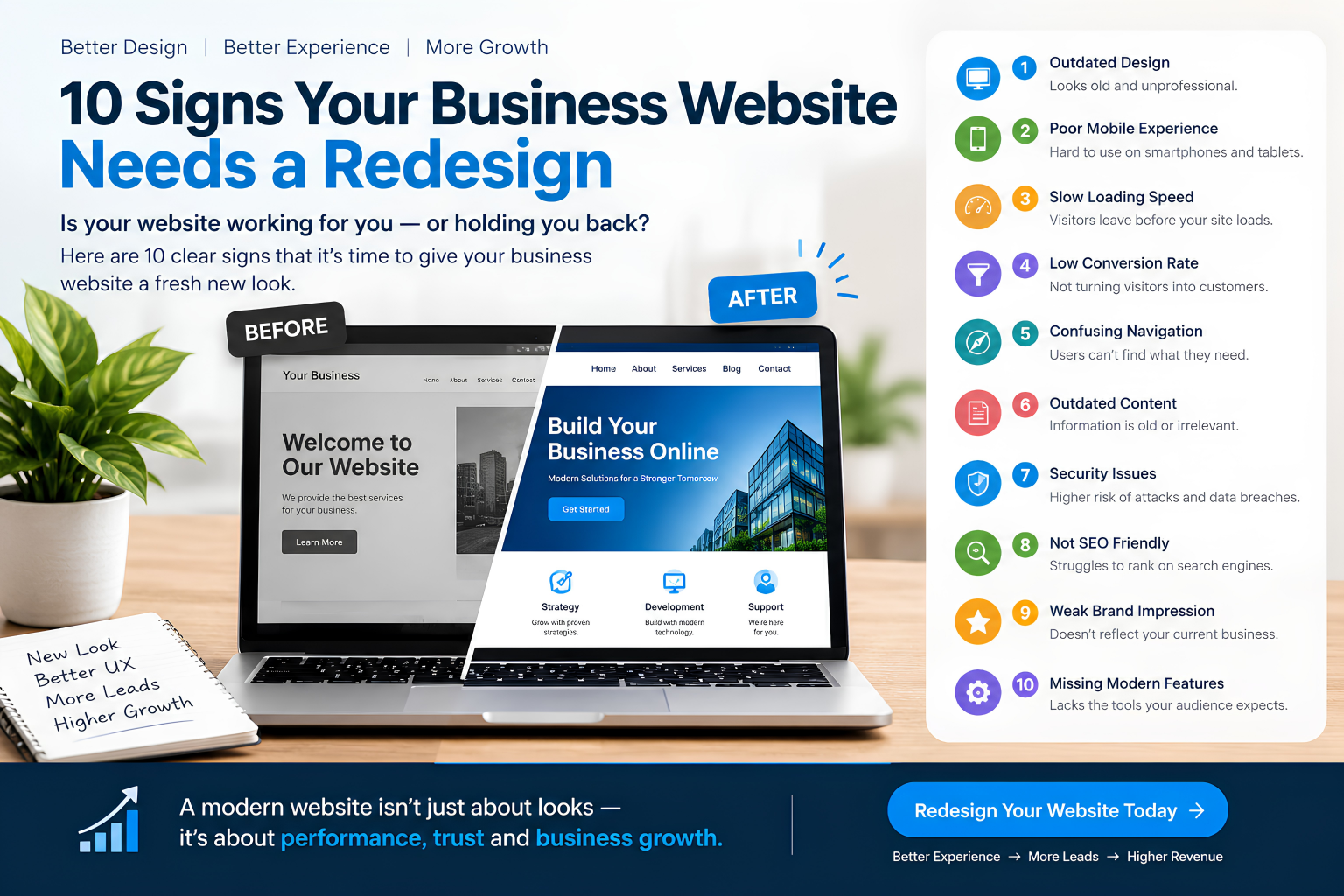
10 Signs Your Business Website Needs a Redesign
A professional website redesign company in India can do far more than make your website look modern. A strategic redesign can improve user experience, mobile performance, SEO, accessibility, lead generation, conversions, and ultimately business growth.
But how do you know when a redesign is actually necessary?
If your website looks outdated, loads slowly, performs poorly on mobile devices, generates fewer leads than expected, or no longer reflects your brand, these may be signals that your website has become a business liability rather than an asset.
A website does not need to be redesigned simply because it is a few years old. The stronger question is:
Is your current website still helping users find information, trust your business, take action, and achieve your business goals?
If the answer is increasingly “no,” it may be time for a redesign.
What Is a Website Redesign?
A website redesign is the strategic improvement of an existing website's visual design, user experience, content structure, functionality, technology, performance, SEO, and conversion paths.
It can range from a visual refresh to a complete rebuild.
| Website Refresh | Website Redesign | Website Rebuild |
|---|---|---|
| Minor visual changes | UX + design + functionality improvements | New technology/architecture |
| Branding updates | Navigation improvements | New CMS/framework |
| Typography/colors | Mobile optimization | Complex functionality |
| Limited development | SEO/performance improvements | Data migration |
| Lower investment | Medium investment | Higher investment |
The right approach depends on the problems your existing website has.
10 Signs Your Business Website Needs a Redesign
1. Your Website Looks Outdated
First impressions matter.
If your website looks like it was designed many years ago, visitors may subconsciously associate its appearance with the quality of your products or services.
Common signs include:
- Old-fashioned layouts
- Excessive text
- Poor typography
- Stock imagery everywhere
- Inconsistent colors
- Cluttered navigation
- Low-quality graphics
- Lack of whitespace
- Desktop-first design
- Outdated visual elements
This is particularly important for businesses in competitive industries such as real estate, healthcare, technology, professional services, hospitality, and e-commerce.
What to do
Don't redesign simply to follow design trends.
Instead, modernize the website around:
Brand → User → Content → Conversion → Performance.
2. Your Website Is Not Mobile-Friendly
Mobile responsiveness is no longer optional.
A website should provide a consistent and usable experience across smartphones, tablets, laptops, and desktops.
Warning signs include:
- Text requiring zooming
- Buttons that are difficult to tap
- Horizontal scrolling
- Images overflowing the screen
- Menus that don't work properly
- Forms that are difficult to complete
- Slow mobile loading
Quick test
Open your website on several real smartphones.
Can someone:
- Understand what you offer?
- Find your contact details?
- Navigate your services?
- Submit a form?
- Make a purchase or booking?
If not, redesign should be considered.
3. Your Website Loads Slowly
Speed directly affects the user experience.
Google's Core Web Vitals currently focus on Largest Contentful Paint (LCP), Interaction to Next Paint (INP), and Cumulative Layout Shift (CLS). The recommended “good” thresholds are LCP of 2.5 seconds or less, INP of 200 milliseconds or less, and CLS of 0.1 or less, measured at the 75th percentile.
A slow website may result from:
- Oversized images
- Poor hosting
- Excessive JavaScript
- Too many plugins
- Unoptimized databases
- Render-blocking resources
- Poor caching
- Inefficient third-party scripts
Redesign opportunity
A redesign is an opportunity to rebuild performance into the architecture rather than simply changing the colors and homepage.
4. Visitors Can't Find Information Easily
Your website may contain excellent information—but if visitors can't find it, that information has limited business value.
Signs of poor information architecture include:
- Confusing menus
- Too many navigation items
- Important services buried several clicks deep
- Missing search functionality
- Poorly structured service pages
- Weak internal linking
- No clear customer journey
A useful rule
Every important page should answer:
Where am I? → What do you offer? → Why should I trust you? → What should I do next?
A good redesign simplifies this journey.
5. Your Website Generates Traffic but Few Leads
This is one of the strongest business reasons to redesign.
You may have:
- Organic traffic
- Social media traffic
- Paid advertising
- Referral traffic
…but still receive very few enquiries.
That suggests a potential conversion problem.
Look at:
- Call-to-action placement
- Contact forms
- Landing pages
- Service descriptions
- Trust signals
- Testimonials
- Pricing information
- Mobile usability
- Page speed
- User journeys
Important distinction
Traffic tells you people arrived. Conversion tells you whether the website persuaded them to act.
A redesign should therefore be measured against business KPIs—not just aesthetics.
6. Your Website Is Not Supporting SEO
An attractive website can still perform poorly in search.
Potential technical and structural problems include:
- Poor URL structure
- Duplicate pages
- Missing or weak metadata
- Thin content
- Poor internal linking
- Slow performance
- Indexation issues
- Missing structured data where appropriate
- Weak heading hierarchy
- Poor image optimization
- No topical content strategy
Google recommends creating helpful, reliable, people-first content and specifically encourages publishers to demonstrate experience, expertise, authoritativeness, and trustworthiness.
A redesign should therefore consider SEO architecture before development begins, not after launch.
7. Your Branding No Longer Matches Your Business
Businesses evolve.
Perhaps your company started as a small local service provider but now serves national or international customers.
Or your product range, positioning, target audience, and brand identity have changed.
If your website still communicates the old business, there is a strategic mismatch.
Consider redesigning when:
- Your target audience has changed
- Your services have expanded
- Your positioning has changed
- Your visual identity has changed
- You now operate internationally
- Your company has moved upmarket
- Your website doesn't reflect your current expertise
Your website should represent where your business is going, not just where it started.
8. Your Competitors Are Providing a Better Digital Experience
Competitive analysis is not about copying competitors.
It is about identifying expectations in your market.
Compare your website against three to five competitors.
Look at:
| Area | Your Website | Competitors |
|---|---|---|
| Mobile experience | ? | ? |
| Page speed | ? | ? |
| Navigation | ? | ? |
| Content depth | ? | ? |
| Trust signals | ? | ? |
| CTAs | ? | ? |
| Visual design | ? | ? |
| Service pages | ? | ? |
| Reviews/testimonials | ? | ? |
If competitors make it significantly easier for customers to understand, compare and contact them, your website may be losing business before your sales team ever gets involved.
9. Your Website Is Difficult to Update
A website should empower your team—not force you to contact a developer for every small change.
If updating:
- Text
- Images
- Blog posts
- Services
- Products
- Team members
- Locations
- FAQs
requires technical intervention every time, your CMS or website architecture may need improvement.
A modern website should provide appropriate editing capabilities while maintaining security and performance.
For many businesses, WordPress remains a practical option. W3Techs reports that WordPress is currently used by 40.7% of all websites and represents 58.9% of websites whose CMS is known.
However, WordPress is not automatically the right solution for every business. The CMS should be selected according to requirements.
10. Your Website No Longer Produces Measurable Business Results
This is perhaps the most important warning sign.
Ask:
- How many leads does the website generate?
- Which pages generate enquiries?
- Which traffic sources convert?
- Which services receive the most interest?
- Where do visitors abandon the journey?
- What is the cost per lead?
- Which landing pages perform best?
- Are organic conversions increasing?
If you cannot answer these questions, the problem may not only be the website—it may be the absence of proper analytics and conversion tracking.
A successful redesign should establish measurable goals.
Example KPIs
- Qualified leads
- Online sales
- Appointment bookings
- Calls
- Form submissions
- Newsletter signups
- Product enquiries
- Conversion rate
- Organic conversions
Should You Redesign or Rebuild Your Website?
Not every problem requires a complete rebuild.
| Problem | Recommended Approach |
|---|---|
| Outdated colors/fonts | Visual refresh |
| Weak branding | Redesign |
| Poor navigation | UX redesign |
| Slow website | Performance optimization/rebuild |
| Poor mobile experience | Responsive redesign |
| Weak conversion rate | CRO + UX redesign |
| Technical limitations | Rebuild |
| Old CMS | Platform migration |
| Complex integrations | Custom development |
| Security vulnerabilities | Technical remediation/rebuild |
A professional website redesign company in India should diagnose the problem before recommending a solution.
Benefits of a Professional Website Redesign
A strategically planned redesign can improve:
User Experience
- Easier navigation
- Better readability
- Clearer information architecture
- Better mobile usability
SEO
- Improved site architecture
- Better internal linking
- Cleaner technical implementation
- Better page experience
- Improved content organization
Conversions
- Stronger CTAs
- Better landing pages
- Simplified forms
- Stronger trust signals
- More intuitive customer journeys
Brand Perception
- Modern visual identity
- Stronger credibility
- Consistent messaging
- Better differentiation
Performance
- Faster pages
- Better Core Web Vitals
- Optimized images
- Reduced technical bloat
Website Redesign Process: Step by Step
A professional redesign should follow a structured process.
1. Website Audit
Analyze:
- UX
- SEO
- Analytics
- Performance
- Security
- Content
- Mobile usability
2. Competitor Research
Identify industry expectations and opportunities.
3. Business & Audience Research
Define target audiences, pain points, user journeys and conversion goals.
4. Information Architecture
Plan navigation, categories, URLs and content relationships.
5. UX/UI Design
Develop wireframes and high-fidelity responsive designs.
6. Development
Implement the new website using the most suitable technology.
7. Content & SEO Migration
Preserve valuable URLs, metadata, content and backlinks where appropriate.
8. Testing
Test:
- Mobile
- Desktop
- Browsers
- Forms
- Links
- Performance
- Accessibility
- Security
- Tracking
9. Launch
Configure redirects, analytics, Search Console, sitemap and monitoring.
10. Post-Launch Optimization
Measure results and improve continuously.
Common Website Redesign Mistakes
Avoid these mistakes:
- Redesigning only for aesthetics
- Ignoring SEO during the redesign
- Changing URLs without redirect planning
- Removing high-performing content
- Choosing technology before defining requirements
- Ignoring mobile users
- Adding unnecessary animations
- Installing excessive plugins
- Failing to configure analytics
- Launching without proper testing
- Not creating backups
- Failing to measure post-launch performance
The most dangerous mistake is treating redesign as a purely visual project.
Best Practices for Business Website Redesign
Before starting a redesign:
- Audit the current website.
- Export analytics data.
- Identify top-performing pages.
- Identify important backlinks.
- Document existing URLs.
- Preserve valuable content.
- Map redirects.
- Establish conversion goals.
- Create mobile-first designs.
- Optimize images.
- Test Core Web Vitals.
- Build SEO into the architecture.
- Add clear trust signals.
- Make calls-to-action obvious.
- Keep forms simple.
- Test before launch.
- Monitor results after launch.
Google explicitly recommends evaluating whether content demonstrates first-hand expertise and whether it provides substantial value beyond what other search results offer.
Website Redesign Trends Businesses Should Watch
AI-Assisted Experiences
AI is increasingly being integrated into search, customer support, recommendations, personalization and business workflows.
Performance-First Design
Modern redesigns increasingly prioritize speed and responsiveness instead of adding visual effects simply because they look impressive.
Conversational Search
Content should answer natural-language questions clearly because users increasingly search using complete questions and conversational phrases.
Structured Content
Well-organized headings, concise answers, FAQs, definitions and entity relationships make content easier for both users and machines to understand.
Accessibility
Inclusive design is becoming an increasingly important component of professional digital experiences.
Data-Driven UX
Analytics, heatmaps, session recordings and conversion data can reveal where users struggle.
Industry-Specific Redesign Examples
Healthcare
A healthcare website may need:
- Doctor profiles
- Appointment booking
- Service pages
- Location information
- Trust signals
- Mobile-first contact options
The redesign should prioritize clarity and trust.
Real Estate
Real estate websites often benefit from:
- Advanced property search
- Filters
- Location pages
- Agent profiles
- Lead forms
- CRM integration
E-commerce
An e-commerce redesign should focus heavily on:
- Product discovery
- Search
- Filters
- Checkout
- Mobile shopping
- Product information
- Trust and reviews
Local Businesses
For local businesses, prioritize:
- Location information
- Google Business Profile integration
- Calls
- Directions
- Reviews
- Local landing pages
- Fast mobile experience
B2B / SMEs
B2B websites should make it easy to understand:
What you do → Who you help → Why you're credible → How to contact you.
Hypothetical Case Study: A Small Business Website Redesign
Imagine a Noida-based B2B company with an outdated five-year-old website.
Before redesign:
- Desktop-first layout
- Poor mobile experience
- Slow service pages
- Generic content
- Weak CTAs
- No conversion tracking
Instead of simply changing the homepage design, the company conducts a complete UX, SEO and conversion audit.
The redesign introduces:
- Mobile-first layouts
- Industry-specific service pages
- Stronger calls-to-action
- Improved page speed
- Better internal linking
- Customer proof
- Lead tracking
- Structured content
The objective isn't simply to create a “prettier” website.
The objective is to create a website that generates measurable business opportunities.
How Much Does Website Redesign Cost in India?
There is no universal price.
The website redesign cost in India depends on:
- Number of pages
- Design complexity
- UX research
- Content requirements
- CMS
- E-commerce functionality
- Custom development
- API integrations
- SEO migration
- Content migration
- Performance work
- Testing
- Ongoing support
A simple visual refresh may cost considerably less than a complete redesign involving UX research, custom development, SEO migration and third-party integrations.
When comparing website redesign services in India, ask for a detailed scope rather than comparing only the headline price.
How to Choose a Website Redesign Company in India
Whether you're searching for a website redesign company in Noida, website redesign services in Delhi NCR, or a broader professional website redesign company in India, evaluate providers using these criteria:
Portfolio
Look for projects similar to your industry and business model.
Strategy
Can the agency explain why specific changes are necessary?
SEO Expertise
Does the team understand redirects, information architecture, technical SEO and content migration?
UX Expertise
Can they demonstrate how design decisions improve usability?
Development Capability
Can they handle integrations, performance and security?
Analytics
Will they measure business outcomes after launch?
Ownership
Make sure you retain appropriate access to your domain, hosting, CMS, analytics and website assets.
Frequently Asked Questions
1. How do I know if my website needs a redesign?
Common signs include outdated design, poor mobile usability, slow performance, confusing navigation, declining conversions, weak SEO, difficult content management and a mismatch between the website and your current business.
2. How often should a business website be redesigned?
There is no fixed schedule. Redesign when the website no longer meets user, technology, brand, SEO or business requirements—not simply because a certain number of years have passed.
3. How much does website redesign cost in India?
Costs vary according to scope. A visual refresh is considerably different from a complete UX, SEO, technology and functionality redesign.
4. Is website redesign good for SEO?
It can improve SEO when technical problems, information architecture, performance and content quality are addressed correctly. However, a poorly managed redesign can also cause traffic loss.
5. Can redesigning a website increase leads?
Yes, if the redesign addresses conversion barriers such as unclear messaging, weak CTAs, poor UX, slow performance and difficult forms.
6. Should I redesign my website or build a new one?
Redesign if the existing technology and architecture can support your future requirements. Consider rebuilding when the platform has serious technical limitations.
7. Is WordPress suitable for a website redesign?
Yes. WordPress can be an effective platform for many business websites, particularly when content management and marketing flexibility are priorities. Its widespread adoption demonstrates the maturity of its ecosystem.
8. Will a website redesign improve Google rankings?
Not automatically. A redesign can create SEO improvements when it solves technical, content, UX and performance problems. Rankings should never be guaranteed simply because a website has been redesigned.
9. What should I do before redesigning my website?
Back up the website, export analytics data, identify valuable pages and backlinks, document existing URLs, review search performance, and establish measurable business goals.
10. What is the difference between redesign and rebuild?
A redesign primarily improves the existing website's experience, design and functionality. A rebuild may involve replacing the underlying CMS, framework or architecture.
11. Should small businesses redesign their websites?
Yes, when their existing website is preventing growth, generating poor leads, providing a weak mobile experience, or failing to communicate their current value proposition.
12. How long does a website redesign take?
The timeline depends on scope. A small redesign can take weeks, while complex enterprise, e-commerce or custom projects may require several months.
13. Can I redesign my website without losing SEO traffic?
Yes, but careful planning is essential. Preserve valuable URLs where possible and implement appropriate redirects when URLs change.
14. What should a modern business website include?
At minimum: responsive design, clear messaging, intuitive navigation, strong CTAs, trustworthy content, secure infrastructure, analytics, SEO foundations, fast performance and easy contact options.
15. What should I look for in a website redesign company?
Look for proven UX, design, development, SEO, analytics and migration expertise—not simply attractive portfolios or the lowest quotation.
Conclusion
Your website is often the first serious interaction a potential customer has with your business.
If it looks outdated, loads slowly, frustrates mobile users, hides important information, generates few leads or no longer represents your brand, redesigning it may be more than a cosmetic improvement—it may be a business growth opportunity.
The best website redesign company in India should not begin by asking, “What design do you want?”
It should begin by asking:
What is your website supposed to achieve?
From there, the redesign should connect business objectives with UX, content, SEO, technology, performance and measurable conversions.
A successful redesign is not simply a newer website.
It is a better-performing business asset.
Ready to Redesign Your Business Website?
If your website is outdated, difficult to manage, slow, poorly optimized, or failing to generate enough enquiries, consider a professional website audit before investing in a complete redesign.
Get a strategic website redesign assessment and identify the highest-impact improvements for your business.